
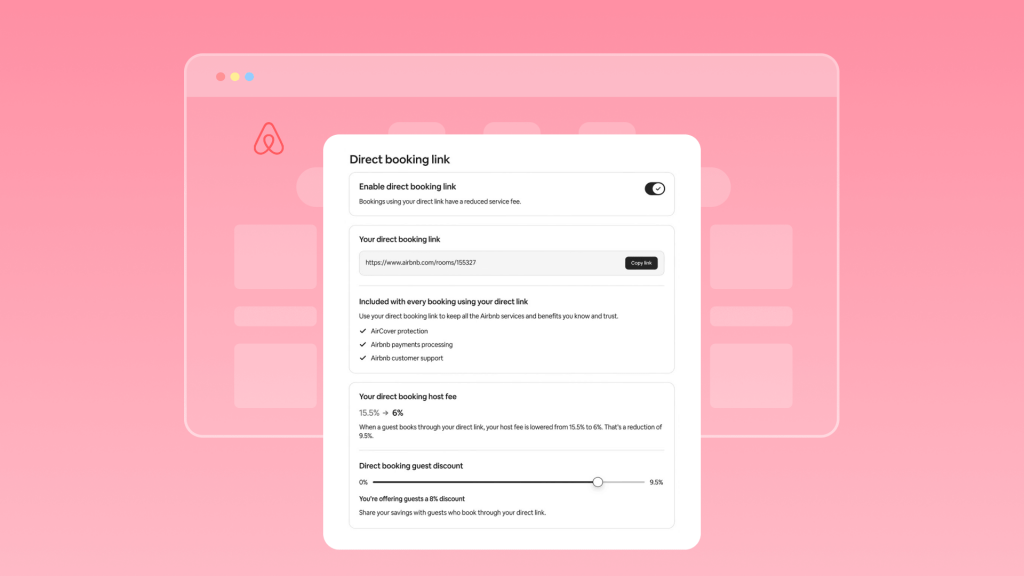
Airbnb direct booking links are changing how hosts think about booking fees and guest acquisition. By offering eligible hosts a lower service fee on reservations made through a special link, Airbnb gives them a financial incentive to bring in their own guests rather than rely entirely on the platform to generate bookings.
But a lower commission raises a bigger question: Is this a meaningful step toward direct bookings, or simply a new way to keep host-referred guests within Airbnb’s ecosystem? To understand whether the feature is worth using, you need to look beyond the fee reduction and consider how it fits into your broader booking strategy.
What Is the Airbnb Direct Booking Link?
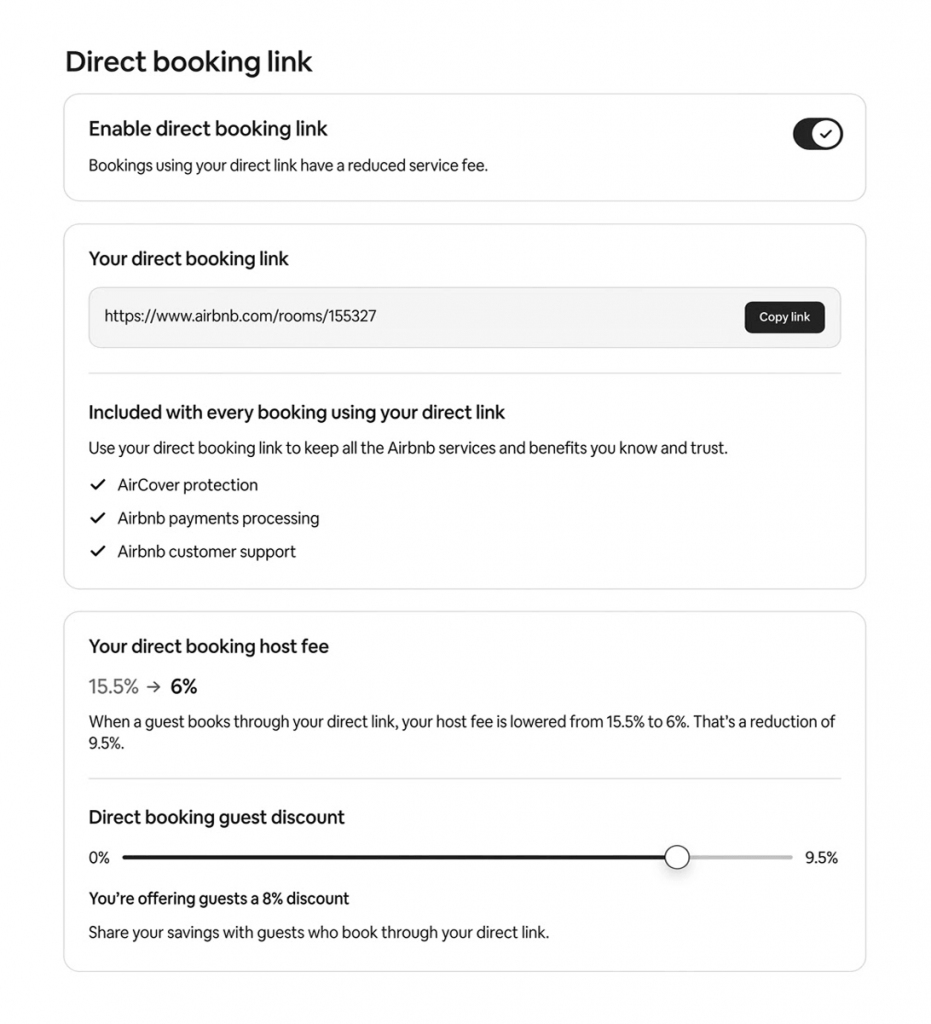
The Airbnb direct booking link is a unique URL that eligible hosts can enable in their listing editor and share through their own websites, social media, and other marketing channels.
The feature is a pilot program available only to selected hosts with eligible listings. Airbnb can change or discontinue it, so access and fee rates are not guaranteed to remain the same.
Here are the key features:
- Lower host service fees: Airbnb has not publicly confirmed a universal discounted rate. Some participating hosts have reported reduced rates of 6% or 10%, compared with the standard 15.5% single host fee that applies to most listings.
- Optional guest discounts: You can keep the fee savings or pass some of them to guests as a discount, potentially making your listing more competitive.
- Bookings remain on Airbnb: Guests still book and pay through Airbnb, with its standard booking process and applicable protections. The link does not create an independent booking channel or give you full control over the guest relationship.
The link can reduce the cost of reservations you generate yourself, but it does not replace your own direct booking website, which offers greater control over branding and customer relationships while requiring you to manage additional costs and responsibilities.
Why Did Airbnb Introduce the Direct Booking Link?
The timing of this feature makes more sense when viewed against Airbnb’s broader fee structure and the growing interest in direct bookings.
1. Higher host fees have increased interest in alternatives.
Under Airbnb’s single-fee model, most hosts pay a 15.5% service fee, making distribution costs more visible than under the traditional split-fee model. This has encouraged hosts to explore ways to reduce commissions, particularly for bookings they generate themselves.
2. Hosts want to benefit from their own marketing efforts.
Property managers increasingly use websites, social media, referrals, and repeat-guest relationships to attract bookings. Paying the standard Airbnb fee for guests they have already acquired can make these efforts less profitable. A reduced fee gives hosts an incentive to bring their own traffic to Airbnb.
3. Airbnb can retain bookings that might otherwise move off-platform.
Rather than letting host-generated demand flow entirely to independent booking websites, Airbnb offers a lower fee while keeping reservations within its ecosystem. Guests continue using Airbnb’s booking and payment systems, while hosts receive a financial incentive to direct potential customers to the platform.
Airbnb Direct Booking Link vs. Your Own Direct Booking Website
The main trade-off is between cost and control. Airbnb’s link lets you get direct bookings without building a separate booking infrastructure. Your own website requires more investment and operational responsibility but gives you greater independence.
| Factor | Airbnb Direct Booking Link | Your Own Direct Booking Website |
|---|---|---|
| Booking process | Guests book through Airbnb | Guests book through your website or booking engine |
| Transaction costs | Reduced Airbnb host service fee on qualifying bookings | Website and booking software costs, payment processing fees, and other operating expenses |
| Guest acquisition | You bring traffic to your Airbnb listing | You attract traffic to your own booking channel |
| Branding | Airbnb’s interface and booking experience | Greater control over your brand and booking experience |
| Customer relationships | Subject to Airbnb’s rules on guest information and marketing | More opportunities for consent-based customer communication and repeat bookings |
| Operational responsibilities | Airbnb handles the platform’s booking and payment processes | You or your service providers manage payment processing and more of the booking workflow |
Which Option Is More Cost-Effective?
Consider a $1,000 reservation. If Airbnb charges a 6% host service fee on a qualifying direct booking link reservation, you retain $940 before other expenses.
If the same booking takes place on your own website and you use Stripe’s standard US domestic card rate of 2.9% plus $0.30, the processing fee is $29.30, leaving $970.70.
| Booking channel | Fee on a $1,000 reservation | Amount remaining |
|---|---|---|
| Airbnb direct booking link at 6% | $60.00 | $940.00 |
| Your website with Stripe domestic card processing | $29.30 | $970.70 |
On these assumptions, your own website leaves you with an additional $30.70 per booking. However, this is not a complete comparison of profitability. You may also need to account for website hosting, booking software, marketing, fraud prevention, refunds, and customer support.
When Should You Use Each Option?
The key is to evaluate each channel by its total costs and the value it brings to your business, rather than comparing commission rates alone.
Choose Airbnb’s direct booking link if:
- You already attract guests through social media, referrals, or other marketing channels.
- You want to get direct bookings without managing an independent booking system.
- You prefer to retain Airbnb’s payment infrastructure and booking support.
Consider your own direct booking website if:
- You have a steady source of website traffic or repeat guests.
- You want greater control over branding, pricing presentation, and the booking experience.
- You want to develop a long-term customer acquisition strategy that is less dependent on online travel agencies.
- You can manage the additional costs and responsibilities of accepting bookings independently.
FAQs on Airbnb Direct Booking Link
Is Airbnb’s direct booking link really a direct booking?
Not in the traditional sense of a reservation completed on the property’s own website.
The link directs guests to an Airbnb listing, and the reservation remains on Airbnb. The main difference is that Airbnb applies a reduced host service fee to qualifying bookings.
How much does Airbnb charge for direct booking link reservations?
Airbnb’s official help article confirms that qualifying reservations receive a reduced host fee but does not publish one universal reduced rate.
Industry reports have described some participating hosts paying 6% or 10%. Your actual rate may differ, so check the Direct booking link section of your listing editor.
Does Airbnb’s direct booking link offer a guest discount?
Yes. Eligible hosts can choose to pass some or all of their fee savings to guests as a discount.
No guest discount is set by default. The discount applies to the relevant listing, and the discounted price remains visible for 24 hours after a guest clicks the link.
Does the Airbnb direct booking link bypass Airbnb’s service fees?
No. It reduces the host service fee for qualifying reservations, but the booking still takes place on Airbnb and remains subject to the applicable fee and booking rules.
Can I use the Airbnb direct booking link on my own website or social media?
Yes. Airbnb explicitly suggests sharing the link through social media profiles, posts, websites, and marketing materials.
You must still follow Airbnb’s policies, including its nondiscrimination and other applicable requirements.
Can I use the Airbnb direct booking link to collect guest emails for future marketing?
You should not assume that you can use contact details obtained through Airbnb for promotional purposes.
Airbnb restricts the use of guest contact information for marketing and prohibits adding guests to contact lists using that information. If you want to build an independent marketing database, use lawful collection methods and obtain the consent required under applicable privacy rules.
Does the Airbnb direct booking link expire?
The link remains active until you disable it. However, a guest discount displayed after clicking the link remains visible for 24 hours. If the guest returns later without clicking the link again, the discount may no longer appear.
Can I convert an existing Airbnb reservation into a direct booking link reservation?
No. Airbnb states that the link applies only to new bookings. Reservations made or initiated without the link cannot be converted afterward.
Is Airbnb’s direct booking link available to every host?
No. Airbnb describes the feature as a pilot program available to a limited number of hosts with eligible listings. The company can change or end the program and can add or remove participating hosts.
How to Set Up and Use an Airbnb direct booking link?
If you’re eligible, open your listing editor on Airbnb and look for the direct booking link option. Enable it, copy your unique URL, and share it on your website, social media, or other marketing channels. Guests who use the link to make a qualifying reservation can receive the applicable discounted host service fee. Availability and settings may vary by host and listing.
Reflexiones finales
Airbnb’s direct booking link is a useful change to the economics of host-referred reservations. It gives eligible hosts a chance to pay less for bookings they help generate, while retaining the convenience of Airbnb’s booking and payment infrastructure.
But the feature does not fundamentally change the relationship between the host and the platform. The reservation still happens on Airbnb, and the host remains subject to its rules and systems.
That is why the most useful question is not simply how much commission you can save. It is how you want to acquire guests and build your business over the long term.
If you already have an audience and prefer to keep bookings on Airbnb, the link may be an easy way to improve your margins. If your priority is to develop repeat business, control more of the customer journey, and reduce dependence on third-party platforms, investing in your own direct booking channel may offer greater long-term flexibility.
The strongest strategy is not necessarily to choose one channel over another. It is to understand what each channel costs, what it provides, and how it fits into your wider distribution plan.

 Spanish
 English
 Japanese
 Arabic
 French
 Russian
 German
 Portuguese
 Korean
 Italian
 Thai