
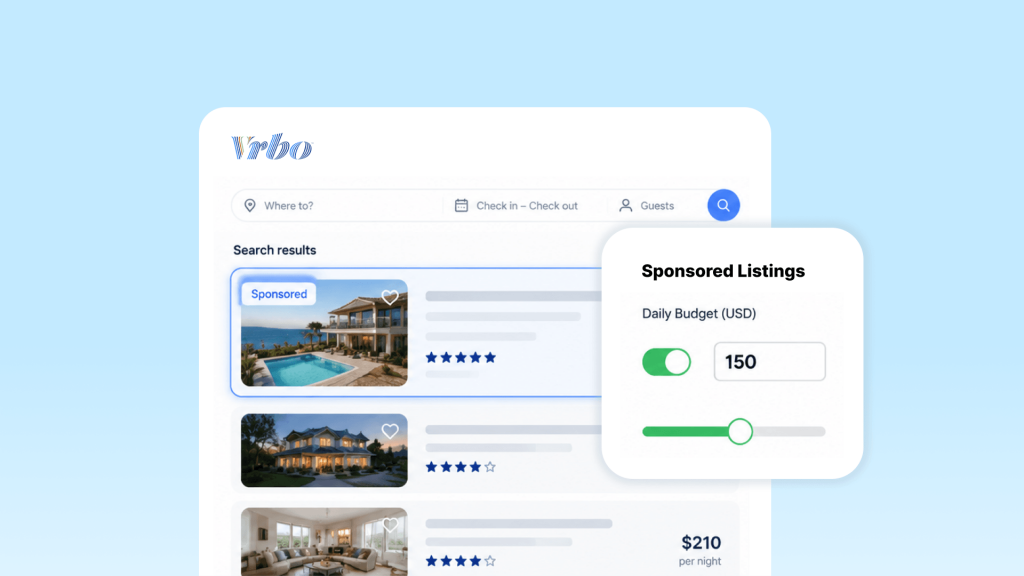
Vrbo sponsored listings are currently being tested as a pay-per-click advertising model. It may allow vacation rental operators to appear higher in Vrbo search results.
At this stage, key details such as pricing, minimum bids, and eligibility rules have not been publicly confirmed. However, the direction across online travel agencies is becoming clearer. OTA visibility is gradually shifting toward a pay-to-play model.
This guide breaks down what is confirmed by Vrbo or Expedia Group, what is still uncertain or changing, and what hosts can do now to stay prepared.
⚠️ Nota importante: Vrbo sponsored listings are still in a testing phase. Nothing here should be read as official policy or final pricing. We will clearly separate confirmed information from industry analysis.
What Are Vrbo Sponsored Listings?
Vrbo sponsored listings are a proposed advertising feature. It would allow hosts and property managers to pay for higher placement in Vrbo search results.
In simple terms, it works like a paid shortcut to visibility.
Vrbo isn’t pioneering this model. The trend toward pay-to-play visibility has been building across OTAs for years. This is similar to Expedia TravelAds in the hotel space, where advertisers pay for exposure in search placements rather than relying only on organic ranking signals.
Vrbo has not fully launched this feature yet. However, Expedia Group is reportedly testing it within its vacation rental ecosystem.
What Vrbo Has Confirmed So Far
Below is a summary based on Expedia Group communications and industry reporting.
- CPC model (cost-per-click): The model is expected to follow a CPC structure. Hosts would pay each time a traveler clicks on a listing. Payment is not tied to bookings.
- Early testing is underway: Tim Rosolio, Expedia Group’s VP of Vacation Rental Partner Success, referred to the feature as a “massive unlock” in comments reported by The Host Report on June 24, 2026.
- Gradual rollout is expected: A wider rollout is expected in the second half of 2026. This depends on how testing performs across different markets. At this stage, there is no confirmed global launch timeline.
- Possible expansion across Expedia Group: Sponsored listings that start on Vrbo are expected to eventually appear on Expedia.com and potentially other Expedia Group sites, using the company’s unified technology platform.
What We Still Do Not Know
Despite early signals, many critical details remain undisclosed.
- Pricing model: No per-click cost information has been shared. For reference, Booking.com’s sponsored listings start around $0.50/click, and Expedia hotel TravelAds CPCs have risen roughly 30% between 2023 and 2025. But Vrbo’s pricing could look entirely different.
- Minimum bid requirements: It is still unclear whether hosts will need to meet a minimum bid level. This will directly affect how competitive smaller operators can be.
- Eligibility rules: Vrbo has not confirmed whether all hosts can participate. Access may depend on performance metrics or account status.
- Ad labeling and transparency: It is not yet known how sponsored listings will be marked in search results. Clear labeling is important for trust and compliance in most OTA advertising systems.
- Market rollout scope: Vrbo has not specified which regions are included in the current tests. It is also unclear which markets will be prioritized at launch.
- Impact on Premier Host program: It is possible that performance tiers could influence eligibility or pricing. However, this remains speculative at this stage.
This is not a complaint list; it is a reminder of where the industry is heading. At this stage, the most responsible position is simple: track what is confirmed, and prepare for what is likely.
How This Compares to Current Vrbo Marketing Tools
Vrbo already offers visibility tools today. The most common is supplier-funded promotions. This typically involves discounting nightly rates in exchange for improved ranking signals.
Here is how the two models differ:
| Tool | Cómo funciona | Estructura de costos | Risk profile |
|---|---|---|---|
| Supplier-funded promotions | Discount rate for algorithmic boost | Pay through reduced revenue per booking | Shared, only costs when booking happens |
| Sponsored listings (CPC model) | Pay for clicks to gain visibility | Pay per click, regardless of booking outcome | Host bears the full upfront traffic cost |
The key difference is timing and certainty. With discounts, cost is tied to bookings. With CPC ads, cost is tied to attention, not conversion.

What Vrbo Sponsored Listings Mean for Hosts?
If Vrbo sponsored listings are fully launched, the biggest change will happen on the search results page.
For both hosts and travelers, visibility would no longer depend only on organic ranking signals. It would also depend on paid placement.
How Search Rankings Could Shift?
Today, Vrbo search results are mainly driven by:
- Guest preferences and search filters
- Property features and pricing
- Listing performance signals
- Host reliability metrics (ratings, response rate, acceptance rate, and cancellation rate)
In most OTA advertising systems, paid listings are shown in high-visibility positions. Vrbo would likely follow a similar structure if it adopts a CPC model.
So if sponsored listings are introduced, paid results would likely be added on top of this system. This creates a layered ranking structure: organic ranking signals + performance metrics + paid placement
Could Lower-Ranked Listings Appear Above Better Performers?
This is one of the most debated impacts among Vrbo hosts. In a pay-to-play system, a lower-performing listing could potentially appear above a stronger organic performer.
The reason is simple. Paid placement can override organic ranking signals in many OTA search systems. This does not remove quality signals. However, it can reduce their visibility advantage.
This is not unique to Vrbo. It is a common pattern in mature OTA markets. Top-performing hosts often end up investing in ads to maintain visibility, not just to grow it.
How Does This Affect the Premier Host Badge?
El Premier Host program has long been Vrbo’s main quality badge, similar to Airbnb’s Superhost. It supports trust signals and can improve organic visibility in search results. However, its role may shift if sponsored listings become more widely used.
Vrbo has also been tightening its Premier Host requirements in recent years through its Performance Milestones framework. These updates raise the bar on key metrics, including guest ratings, response speed, acceptance rate, and cancellation rate. In practice, this means organic visibility is already more competitive, even without paid placements.
At the same time, some industry analysis suggests that performance tiers could eventually influence access to advertising products. This has not been confirmed by Vrbo. However, it aligns with how many OTA platforms structure ad eligibility.
If that direction develops, Premier Host status could serve two roles: a ranking signal for organic search and a potential requirement for participating in sponsored listings. In that case, the badge would shift from being a competitive advantage to becoming a baseline condition for visibility across both organic and paid channels.

What You Can Do Now to Prepare for Vrbo Sponsored Listings
The uncertainty around Vrbo sponsored listings is real. But waiting for full clarity is not a strategy.
The good news is that most of the steps that prepare you for this change will also improve your performance today, regardless of how the rollout unfolds.
1. Audit Your Vrbo Listing Performance
Before you can decide whether to advertise, you need to know where you stand today.
Focus on:
- Your current organic position in the Vrbo search for your market
- Estimated click-through rate from search results
- Conversion rate from views to bookings
- Your Premier Host status and whether you’re close to the thresholds
Vrbo does not provide all of this data directly. However, even rough estimates are useful.
2. Improve Your Premier Host Metrics Early
If sponsored listings eventually require performance eligibility, early preparation matters. Even if that does not happen, these metrics already affect organic visibility.
Focus on the areas that actually move rankings:
- Guest ratings (small improvements in service quality and listing accuracy)
- Acceptance rate (being selective about which booking requests you decline)
- Cancellation rate (reducing avoidable cancellations)
- Response rate and speed (mensajería automatizada can help here)
Small improvements here often compound over time. For most operators, this is also the lowest-risk optimization work available.
3. Build a Budget for Paid Visibility
Even though we don’t know the CPC pricing yet, you can start thinking about your advertising ceiling.
Start with three questions for each property:
- What’s my average net revenue per booking on Vrbo?
- What’s my estimated conversion rate from click to booking?
- What’s the maximum acceptable cost per click?
For example:
if a booking generates $500 in net revenue and your conversion rate is 5%, you need about 20 clicks per booking. That means your break-even CPC is $25 before profit. In reality, you would want to stay well below that level.
Running these numbers now – even with rough estimates – helps you react quickly once real pricing is announced.
4. Diversify Your Booking Channels
If Vrbo introduces paid visibility, acquisition costs on that platform may increase. The simplest hedge is to ensure you’re not overly dependent on any single platform.
A healthier structure usually includes:
- Listing on multiple OTAs (Airbnb, Booking.com, Google Vacation Rentals)
- Building a direct booking website to capture repeat guests and referral traffic at zero commission
- Using a channel manager to keep availability and pricing synced across platforms
The more channels you have, the less leverage any single platform’s policy has over your business.

Final Thought: Monitor the Testing Phase Closely
This isn’t a set-and-forget situation. Vrbo’s test results will determine how (and whether) sponsored listings expand.
Stay close to developments by:
- Following official Vrbo partner communications
- Monitoring industry coverage from Skift, The Host Report, and Rental Scale-Up
- Participating in host and property manager communities, where early experiences are often shared first
The operators who react early usually have a pricing and visibility advantage later.


 Spanish
  English
  Japanese
  Arabic
  French
  Russian
  German
  Portuguese
  Korean
  Italian
  Thai
Thai