

TL;DR: Successful vacation rental marketing doesn’t require a corporate budget. Independent hosts can drive consistent growth by focusing on these high-impact, low-cost areas:
- Build a direct booking website to eliminate platform fees and regain control over guest relationships.
- Choose social media platforms where your guests actually hang out and post consistently.
- Use email marketing to turn past guests into repeat bookings; it is your highest ROI channel.
- Partner with neighborhood businesses for cross-promotion and local SEO benefits.
- Get more 5-star reviews to boost your rankings and booking confidence.
Tools like Hostex simplify the technical aspects of direct booking management, automated guest communication, and calendar synchronization across platforms, allowing you to focus on the hospitality and marketing that differentiates your properties. Start from $4.9/month!

The marketing strategies that work for large-scale operators often fail for independents because they rely almost entirely on scale. For example, a $50,000 annual Google Ads budget makes sense for a company managing 500 properties. However, for a host with only three listings, that approach is simply impossible.
Instead of outspending the giants, independent hosts must leverage their natural strengths. This guide focuses on proven vacation rental marketing tactics that drive growth without a corporate budget. We will explore how to build a direct booking strategy, engage guests on social media, and master the SEO fundamentals that truly matter for small-scale operators.
5 Core Strategies for Successful Vacation Rental Marketing
Strategy 1: Build Your Direct Booking Website
Third-party platforms like Airbnb and Vrbo typically charge 15% to 20% in host-related fees. If your nightly rate is $200, you are effectively losing $30 to $40 per booking to platform commissions. Over 100 bookings annually, those fees stack up to a staggering $3,000 or $4,000 in lost revenue.
Building a direct booking website eliminates these middleman costs. More importantly, it grants you full control over guest relationships, cancellation policies, and flexible pricing strategies.
Must-Have Elements for Your Website
Your site does not need to be overly complex, but it must be functional and professional to win guest trust.
- A High-Quality Property Showcase: Include at least 20 professional photos per property. Use virtual tours or video walkthroughs and detailed amenity lists to set clear expectations.
- A Seamless Booking Engine: Ensure you have a real-time availability calendar, secure payment processing, and a mobile-responsive design for guests booking on the go.
- Essential Trust Signals: Display genuine guest reviews and a host bio with a personal photo. This humanizes your brand and reassures travelers.
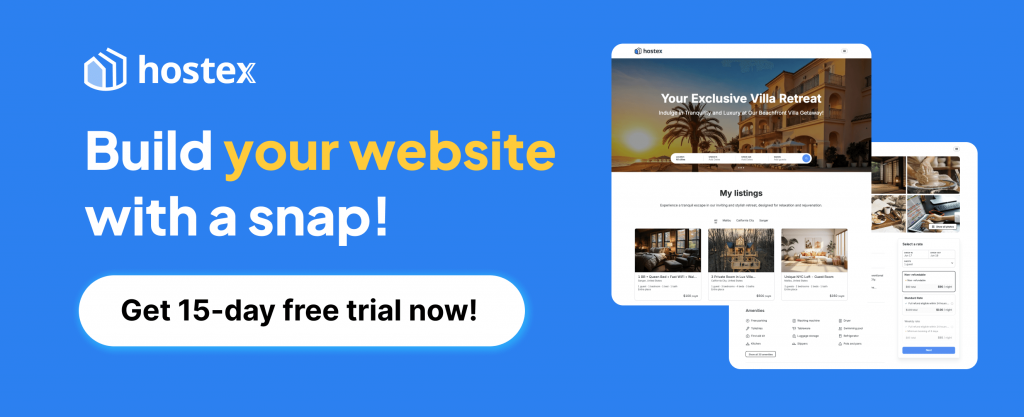
Modern tools like Hostex provide built-in website builders that sync directly with your existing calendars. This makes the setup straightforward, even if you have zero technical expertise.
How to Drive Traffic Without a Budget
A website only works if people find it. You can grow your vacation rental marketing reach using these low-cost methods:
- Convert Existing Platform Guests: Include your website URL in pre-arrival messages. You can also place business cards in your welcome packages to encourage future direct bookings.
- Optimize for Local SEO: Claim your Google Business Profile and list your property on local tourism boards. These are often free and highly effective for local visibility.
- Leverage Content Marketing: Start a small blog about your destination. Create neighborhood guides that rank for specific local search terms to attract travelers looking for “insider tips.”
With Hostex, you can build a custom direct booking site and launch it on Google Vacation Rentals with a single click. This puts your listings directly on Google Maps, helping you capture high-intent traffic at no additional cost.
Strategy 2: Turn Social Media Traffic into Bookings
As an independent host, you cannot be everywhere at once. Instead of spreading yourself thin, choose your platforms based on where your target audience spends their time:
- Instagram: This is the gold standard for visual storytelling. It is ideal for reaching travelers aged 25 to 40, especially if you have a design-focused or luxury property.
- Facebook: Still highly effective for reaching families and travelers over 40. It is also the best place to engage with local community groups.
- Pinterest: A hidden gem for vacation rental marketing. Pins have a long shelf life and capture guests in the early planning stages of their trip.
- TikTok: Perfect for unique properties or experiential stays that benefit from short, engaging video content.
Content Pillars That Drive Results
To keep your feed professional and engaging, focus your energy on these four content categories:
Destination Content (40%)
Your property is just one part of the trip. Share local attractions, hidden gems, and your personal restaurant recommendations. This positions you as a local expert.
Behind the Scenes (30%)
Show the effort that goes into your guest experience. Share the property preparation process, your latest maintenance projects, or even a quick video of you shopping for local guest amenities.
The Guest Experience (20%)
Social proof is essential. Share guest reviews (with permission) or photos of special occasions celebrated at your home. This helps potential guests visualize their own stay.
Direct Response (10%)
Use this sparingly to announce last-minute availability, special seasonal offers, or exclusive direct booking incentives.
Consistency Over Frequency
In the world of social media, consistency always beats frequency. A sustainable schedule for a busy host might look like this:
- Instagram: 4 to 5 posts per week, supplemented by daily Stories for more personal updates.
- Facebook: 2 to 3 posts per week, focusing on active participation in local travel groups.
- Pinterest: 5 to 10 pins per week, which you can easily batch and schedule in advance.
To manage this without daily stress, use scheduling tools like Buffer or Meta Business Suite. This allows you to plan your short-term rental social media strategy in one afternoon, leaving you more time to focus on hosting.
Strategy 3: Email Marketing for Repeat Bookings
Email marketing consistently delivers the highest return on investment of any marketing channel. For vacation rental owners, this tool is exceptionally powerful because your past guests already know and trust your brand. It is far easier to convince a happy guest to return than it is to find a new one.
Building Your Guest List
To grow a high-quality list without spending a fortune, consider these simple tactics:
- Incentivize Direct Signups: Offer a small discount (5% to 10%) for guests who subscribe to your email list through your website.
- Use Lead Magnets: Provide valuable content like a “Local Hidden Gems Guide” or a “Beach Trip Packing List” in exchange for an email address.
- Capture Details During Booking: Ensure you collect email addresses during the checkout process while maintaining a clear privacy policy.
Campaign Types That Drive Repeat Bookings
You do not need to send emails every day. Instead, focus on a few high-impact sequences:
1. Automated Pre-Arrival & Post-Stay Sequences
Automation ensures you stay top-of-mind without manual effort. Send a thank-you note the day after checkout, followed by a review request and an exclusive “return guest” discount code.
2. Seasonal & Holiday Promotions
Reach out four to six times a year with targeted offers. For example, announce early-bird discounts for peak summer dates or create special holiday packages to fill gaps in your calendar.
3. Monthly Newsletters
Keep your property fresh in their minds by sharing local event updates, recent property improvements, or insider travel tips for your destination.
Subject Lines That Actually Get Opened
The best subject lines are personal and concise. Aim for under 50 characters and avoid “spammy” words like urgent or free. Some effective examples include:
- Your [City] summer guide is here
- A special 15% discount for your return visit
- New: We just added a hot tub to the lake house!
Seamless Automation with Hostex and OpenClaw
To truly scale your efforts, Hostex now supports API integration with OpenClaw, unlocking advanced automation for your email marketing strategy.
By analyzing your guest database within Hostex, OpenClaw can automatically trigger personalized messages to specific guest segments. Whether it is a timely welcome note or a tailored seasonal promotion, you can ensure the right message reaches the right guest at the perfect moment, all without lifting a finger.
Strategy 4: Local Partnerships and Cross-Promotion
Local businesses need steady customers, and you need high-quality recommendations for your guests. This mutual benefit creates a natural opportunity for vacation rental marketing that costs nothing but a bit of networking time.
Identifying High-Value Partners
Look for businesses that complement the guest experience without competing for the same booking:
- Dining & Experience: Partner with local cafes, bistros, or unique activity providers like tour operators and equipment rental shops.
- Event Planning: Connect with wedding planners or local event venues that often need group accommodations for their clients.
- Professional Networks: Build relationships with corporate housing providers or even other non-competing hosts for a referral exchange during overbooked periods.
How to Structure Win-Win Arrangements
You don’t need complex legal contracts to start. Most successful partnerships focus on one of three simple models:
- Affiliate Perks: This is the easiest starting point. You recommend their business in your digital guidebook, and in exchange, they offer your guests a small discount. You can also swap business cards or cross-promote each other on social media.
- Commission-Based Referrals: For higher-value services like guided tours, you can agree on a 10% to 15% commission for every booking you generate. Track these easily using unique promo codes or dedicated referral links.
- Themed Experience Packages: Create “all-in-one” bundles, such as a “Romantic Weekend Getaway” that includes a dinner voucher, or an “Adventure Package” featuring local excursions. This adds massive perceived value to your listing.
The Hidden Impact on Local SEO
Beyond direct bookings, these partnerships significantly boost your short-term rental SEO. When local businesses link to your website or mention your brand online, it creates powerful local citations.
Furthermore, engaging with local businesses on your Google Business Profile and creating collaborative content tells search engines that your property is a central part of the community. Consequently, your listing is more likely to appear in the “Local Pack” when travelers search for accommodations in your area.
Strategy 5: Elevate Your Reputation with Five-Star Reviews
The numbers speak for themselves: properties with a 4.8-star rating and over 50 reviews book 35% more frequently than those with lower scores. In the world of vacation rental marketing, your reputation is your strongest currency.
Consistent, high-quality reviews directly influence your platform algorithm ranking, build guest confidence, and give you the pricing power to command higher rates.
A Systematic Approach to Gathering Reviews
Don’t leave your reputation to chance. Use a structured process to ensure satisfied guests share their experiences:
- Perfect Your Timing: The best time to ask for a review is 24 to 48 hours after checkout. Guests are typically most positive immediately after a great stay. If you wait too long, the emotional connection to the experience begins to fade.
- Remove All Friction: Make the process as easy as possible. Provide direct links to your review platforms in follow-up emails, or include a QR code on your printed welcome materials.
- Engage with Every Response: Always thank guests for their positive feedback and mention specific compliments they made. If you receive a negative review, remain professional. Apologize, explain the situation calmly, and offer to make it right. Most importantly, never argue with a guest in a public forum.
Navigating Platform-Specific Rules
Different platforms handle feedback in different ways, and understanding these nuances is key to your reputation management strategy:
- Airbnb: Reviews are double-blind, meaning neither party sees the other’s comments until both are submitted. This encourages honesty but requires you to be proactive in your own hosting reviews.
- Vrbo: Feedback is often visible immediately after submission. This allows you to see guest comments before deciding how to respond or whether to leave a reciprocal host review.
- Google Vacation Rentals: Reviews here are vital for local SEO. Encourage your direct booking guests to leave reviews on Google, as this significantly boosts your visibility in local search results and on Google Maps.
By treating every review as a marketing asset, you can build a self-sustaining booking engine fueled by guest trust and social proof.

Common Pitfalls to Avoid in Vacation Rental Marketing
Even the most dedicated hosts can fall into traps that stifle their growth. Recognizing these common mistakes is the first step toward building a more resilient and profitable business.
Mistake 1: Relying Entirely on Third-Party Platforms
While platforms like Airbnb and Vrbo are excellent for visibility, they ultimately own the guest relationship. A single algorithm shift, policy change, or sudden account suspension can eliminate your income overnight. To protect your business, you must diversify your booking sources and build your own brand.
Mistake 2: Inconsistent Marketing Efforts
Marketing is a marathon, not a sprint. Sporadic social media posts or occasional blog updates rarely yield meaningful results. Instead of trying to do everything at once, commit to a sustainable schedule that you can realistically maintain over the long term. Consistency is what builds trust with your audience.
Mistake 3: Ignoring Your Past Guests
It is a well-known industry fact that acquiring a new guest costs five to seven times more than retaining an existing one. Past guests who have already had a positive experience are your highest-probability leads for future bookings. If you aren’t staying in touch with them, you are leaving money on the table.
Mistake 4: Competing Solely on Price
Engaging in a “race to the bottom” with your pricing will eventually destroy your profitability. Instead of cutting rates, focus on competing through value, unique experiences, and clear positioning. Guests are often willing to pay a premium for properties that effectively communicate their unique advantages.
Mistake 5: Neglecting the Mobile Experience
Current data shows that over 70% of travel research now happens on mobile devices. If your direct booking website, checkout process, or marketing emails do not function flawlessly on a smartphone, you are losing bookings to competitors who offer a smoother mobile experience.
FAQs About Vacation Rental Marketing
How much should I budget for marketing as an independent host?
A good rule of thumb is to reinvest 5% to 10% of your gross revenue into marketing. For a property generating $50,000 annually, this translates to a budget of $2,500 to $5,000 per year. We recommend allocating 60% of this to your direct booking website and essential tools, 30% to professional photography and content creation, and the remaining 10% to any paid advertising.
What is the most important marketing channel for new hosts?
Initially, your focus should be on platform optimization. Ensure your listings on Airbnb, Vrbo, and Booking.com are fully optimized with professional photos and competitive pricing. These platforms provide the immediate visibility you need while you work in the background to build your own direct booking infrastructure.
How long does it take to see results from direct booking marketing?
Building a consistent stream of direct bookings is a long-term play. Typically, it takes 6 to 12 months to see meaningful volume. Short-term rental SEO takes time to mature, and email lists grow gradually. However, this investment pays off significantly through lower commission costs and higher guest lifetime value.
Should I hire a marketing agency?
For most small-scale operators, the answer is likely no. Many agencies charge monthly retainers that are simply unsustainable for a few listings. It is often better to learn the fundamentals yourself first. If you do hire help, focus on specific, high-impact tasks like professional photography or technical website development rather than ongoing management.
How do I compete with large property management companies?
Your competitive advantage lies in the things large corporations cannot easily scale: personal attention, deep local expertise, and authentic human connection. While large managers optimize for operational efficiency, you can optimize for the guest experience. Make sure your vacation rental marketing highlights these personal touches that make your property unique.
Conclusion
Independent vacation rental hosts can compete effectively in 2026’s crowded market by focusing on strategies that leverage their natural advantages. Direct booking websites eliminate platform fees and build guest relationships. Strategic social media presence creates visibility without massive ad spend. Email marketing drives repeat bookings at minimal cost. Local partnerships expand reach through mutual benefit.
The key is consistency over intensity. Sustainable marketing beats sporadic bursts of activity. Start with the fundamentals, measure results, and gradually expand what works for your specific properties and target guests.
 English
  Japanese
  Spanish
  Arabic
  French
  Russian
  German
  Portuguese
  Korean
  Italian
  Thai
Thai