
Most vacation rental hosts think about payment processing only when something breaks. A depósito does not release on time. A reserva direta sits unpaid. A payout shows up three days late, and nobody can say why.
That reactive habit costs more than the occasional fee. It leaves cash flow invisible and puts a stranger’s processor between you and your revenue.
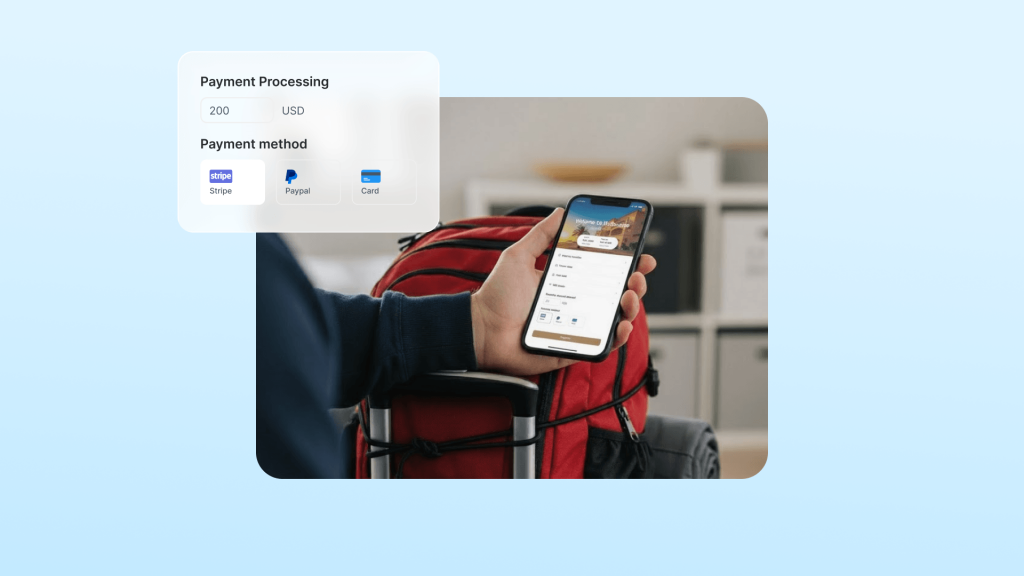
This guide covers how vacation rental payments actually move, where hosts lose money, and how to set up a system where rent, deposits, and direct bookings all flow into an account you control.
Resumindo:
- Payment processing for short-term rentals involves collecting rent, holding depósitos de segurança, accepting reservas diretas, and reconciling all of it with your reservations.
- Security deposits work best as an authorization hold, not a charged balance, so guests are only debited if there is damage.
- Connecting your own Stripe or PayPal account lets money land directly in your account instead of sitting with a middleman’s processor.
- Hostex ties deposits and direct bookings to each reservation, so reconciliation stays in one place without a separate spreadsheet.

What Vacation Rental Payment Processing Covers
Payment processing is not one transaction. It is the set of steps that move money from a guest to a host and keep the records straight.
1. Collecting rent from channel bookings
When a guest books through Airbnb, Booking.com, or Vrbo, the platform collects payment and pays you on its schedule. You rarely touch the card. Your job is to confirm the payout arrived and matches the reservation.
2. Holding a security deposit
A deposit protects you against damage and missing items. The cleanest method is an authorization hold: the guest’s card is frozen for the amount, but no money moves unless you claim it. If the stay is clean, the hold simply expires.
3. Taking direct and off-platform bookings
Guests who book through your own site or by message still need to pay. This is where many hosts improvise with bank transfers and follow-up texts, and where payments get lost.
4. Reconciling payouts and fees
Every booking carries a processor fee, a channel fee, and often a currency conversion. Reconciliation is matching each payment to its reservation so you know what you actually earned.
5. Handling refunds and disputes
Cancellations, partial refunds, and chargebacks all pull money back out. A system that links the refund to the reservation saves hours at tax time.
How Rent and Deposits Move Between Guest and Host
Understanding the path helps you spot where a setup is leaking cash. There are two flows, and they hand you different amounts of control.
| Channel booking | Direct booking | |
|---|---|---|
| Who collects payment | The platform | You |
| Fee stack | Platform commission on top of the processor fee | Processor fee only |
| Deposit handling | Platform or you | You, via your own gateway |
| Dispute ownership | Platform process | Yours to answer |
| Margin kept | Lower after commission | Full, minus the processor fee |
On a channel booking, the platform takes the guest’s payment, deducts its commission, and releases your share on a fixed schedule.
For direct bookings, you own the whole chain. You present the price, you collect the card, you release the funds, and you answer for any dispute. That freedom is why direct bookings protect your margin, but it also means the payment tooling is your responsibility.
The deposit is the part hosts get wrong most often. Charging the full deposit up front and promising to send it back later creates trust friction and a manual refund task after every stay. An authorization hold removes both problems: the card is reserved, not drained, and the money never leaves the guest unless you file a claim.
Security Deposits Without the Paperwork
A deposit only protects you if it is actually collected and actually released on time. Doing that by hand for every checkout is a part-time job. The fix is to connect your own Stripe account and let the software run the hold per reservation.
Here is the cycle on a typical stay:
- You link the Stripe account you already use for your business.
- You set a deposit amount in the check-in guide, per property or globally.
- The guest authorizes the hold before they can view the address and door code.
- The hold sits on the card for up to seven days, matching Stripe’s authorization window.
- Clean stay: the deposit releases automatically, usually at 20:00 on the checkout date.
- Damage found: you deduct the amount from the deposit dashboard before it auto-refunds.
Two details keep this clean at scale. The deposit amount can be set per property, so a studio and a six-bedroom cabin do not carry the same hold. And because the deposit is tied to the reservation and the check-in guide, its status shows on the calendar and the booking page without a separate payments app.
Stripe is a PCI Level 1 certified provider, the top tier of payment security, so card data stays with the processor and out of your inbox.

Taking Direct Bookings and Manual Reservations
Direct bookings are the highest-margin channel you have, because no OTA takes a cut. They also put the payment fully in your hands.
A direct booking site that collects payment
Hostex includes a direct booking website builder. You list your properties, set rate plans, and add your own payment gateway. The gateway can be Stripe or PayPal, and when a guest checks out, the payment goes straight into your account. You can also run the site in request-only mode if you would rather confirm and invoice manually, but the built-in gateway is what turns a brochure into a working checkout.
Manual reservations for off-platform guests
Not every booking comes through a site. A returning guest who texts you, a corporate stay arranged by email, or a neighbor’s referral all land as manual reservations. In Hostex you create the reservation, enter the payout breakdown including cleaning and extra-guest fees, and choose how to handle payment: mark it received, leave it open, or create a charge to collect later. The record stays attached to the booking so your books stay clean.
The combination matters more than either feature alone. A direct site brings in the booking, a manual reservation captures the one that did not, and both feed the same financial view.

Why Connecting Your Own Merchant Account Wins
Some all-in-one platforms route every payment through their own processor. The pitch is convenience, but the cost is control. Connecting your own Stripe or PayPal account flips the relationship.
| Platform-owned processor | Your own Stripe or PayPal | |
|---|---|---|
| Where funds sit | In the platform’s account | Directly in your account |
| Fee you pay | Processor fee plus a platform markup | The processor’s published rate |
| Payout timing | The platform’s schedule | Whatever your provider offers |
| If you switch tools | Funds and history held by the platform | Account and history stay with you |
The difference is who controls the cash. With your own account, the payment goes to you, you pay the published rate, and you set the payout timing because the account is yours. If you ever leave the platform, your payment history and merchant relationship travel with you instead of being held hostage.
This is not a downgrade in oversight. Because Hostex ties the deposit and the direct booking to the reservation, the financial data still lands in one place. You get the control of your own account and the consolidation of a single dashboard, which is the part that actually saves reconciliation time.
For hosts who already run a Stripe or PayPal account for other sales, this means one less new relationship to manage and one less statement to reconcile.
Payment Processing Mistakes That Cost Hosts
A few habits turn a clean setup into a monthly scramble.
- Mixing personal and business accounts. A personal PayPal or Stripe profile triggers holds and tax headaches the moment volume climbs. Open a business account before the first booking.
- Charging deposits instead of holding them. A hard charge means a manual refund after every stay. Use an authorization hold so clean guests feel nothing.
- Letting a processor sit between you and your cash. If a tool holds your funds and releases them on its own clock, you are financing its float with your revenue.
- Skipping deposit automation. Manual deposit collection gets forgotten, and forgotten deposits are unprotected stays.
- Reconciling by memory. Matching payouts to reservations in your head works until the tenth booking of the month. Keep the payment attached to the booking.
- Ignoring chargeback terms. Every processor has a dispute window. Know yours before you promise a guest a refund.
How to Connect Your Payment Accounts in One Place
Setup is a one-time task that pays back on every booking.
Open your payment settings and connect your Stripe account. The integration takes a few minutes. If you run a direct booking site, add PayPal alongside Stripe so guests can pick their method.
Once the accounts are connected, set your deposit rules in the check-in guide so every reservation collects and releases on schedule. For direct bookings, publish your site with the gateway live so checkout is instant.
Day to day, the work shrinks to exceptions. Triggered Messages can remind guests about balances and checkouts. The unified inbox pulls guest payment questions next to the booking they refer to. HostGPT drafts replies to common payment queries so a “where is my deposit refund” message gets a same-minute answer. None of this requires you to open a separate payments dashboard.
The hosts who stress least about money are not the ones with the fanciest processor. They are the ones whose payments are tied to their reservations from the first hold to the final payout.
Perguntas frequentes
What does vacation rental payment processing cost?
You pay a processor fee on each transaction, usually a percentage plus a fixed amount, set by Stripe or PayPal rather than the software layered on top. Channel bookings add the platform’s commission on top of that. The variable you control is whether an extra platform fee is stacked on the processor rate.
Do I need my own Stripe account to take deposits?
For an authorization-hold deposit, yes, a connected Stripe account is what places and releases the hold on the guest’s card. It is your account, so the funds and the relationship stay with you.
How does a security deposit authorization work?
The guest’s card is reserved for the deposit amount but not charged. If the stay is clean, the hold expires with no movement. If you claim damage, you capture the amount within the processor’s window, often seven days.
Can I use PayPal instead of Stripe?
PayPal works as a gateway on a direct booking site alongside Stripe, so guests can pay with either. Deposit holds specifically run through Stripe, so keep a Stripe account connected even if most direct bookings go through PayPal.
How fast do payouts reach me?
That depends on your processor, not the booking software. Because the money lands in your own Stripe or PayPal account, your payout speed is whatever those providers offer, and you are not waiting on a middleman’s schedule.
Are direct bookings worth the payment setup?
Yes, when the volume covers the small setup time. Every direct booking avoids the OTA commission, and a connected gateway turns the site from a brochure into a real checkout.
Conclusão
Payment processing for vacation rentals is less about choosing a processor and more about managing the entire payment flow. Collect rent and deposits securely, accept direct bookings through a gateway that pays you directly, and link every payment to its reservation to simplify reconciliation.
With the right approach to vacation rental property management, you can keep payments organized and spend less time tracking down money.

 Portuguese
  English
  Japanese
  Spanish
  Arabic
  French
  Russian
  German
  Korean
  Italian
  Thai
Thai