
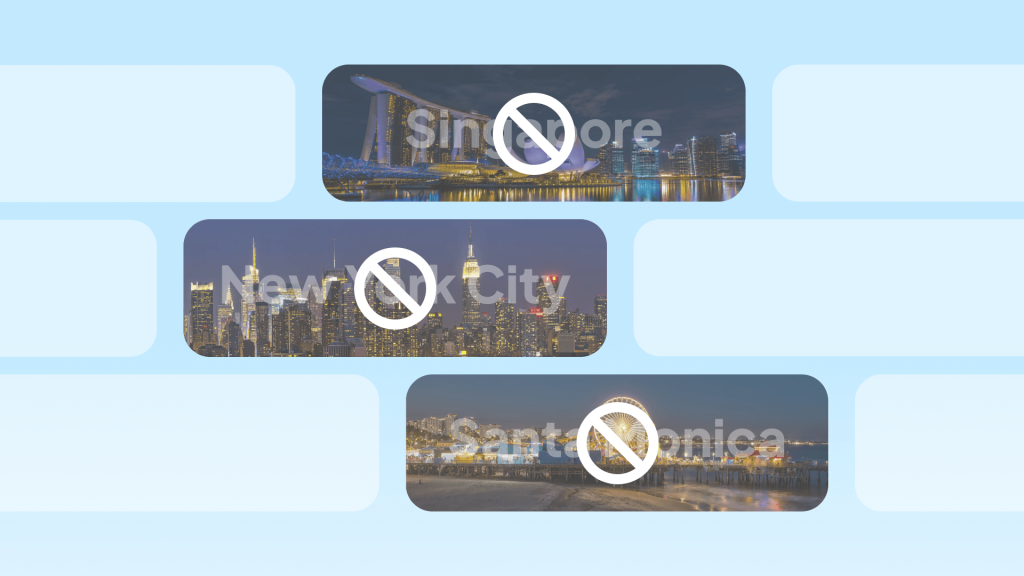
Did you know that Airbnb hosting is not allowed everywhere? If you’re planning to start an Airbnb business, it’s important to know where Airbnb is banned or restricted before you invest in a property.
The restrictions do not necessarily make Airbnb itself illegal. They determine which properties can legally accommodate short-term guests and under what conditions.
This guide covers selected cities with significant short-term rental restrictions, explaining what the rules mean for hosts and travelers.
Where Is Airbnb Banned or Nearly Banned?
In some markets, local regulations make ordinary residential properties unsuitable for short-term stays. In others, hosting remains legal only under specific conditions.
Singapore
Singapore prohibits short-term tourist stays in residential properties. Private residential properties generally require a minimum stay of three consecutive months, while HDB flats and bedrooms require at least six months. Hotels and qualifying serviced apartments operate under different rules.
Listing a residential property for stays shorter than the permitted minimum can result in enforcement action and substantial fines.
New York City
New York City introduced Local Law 18 in 2023, significantly restricting short-term rentals in residential properties.
The city has not prohibited all short-term hosting: eligible residents can still offer compliant stays.
For stays of fewer than 30 days, hosts generally must register with the city’s Office of Special Enforcement, remain in the same dwelling unit during the stay, and accommodate no more than two guests at a time.
Santa Monica, California
Santa Monica generally prohibits short-term rentals of 30 days or less in residential properties, except for approved home-sharing arrangements where the host lives on-site.
Hosts must obtain the required business license and comply with local regulations.
Where Is Short-term Rental Strictly Restricted?
Other cities or countries permit short-term rentals but impose conditions that restrict how often a property can be rented, who can host, or which properties qualify.
| City/Country | Main restriction | Key rule |
|---|---|---|
| Amsterdam | Permit, registration, and residence requirements | Generally 30 nights per calendar year, reduced to 15 in eight designated neighborhoods |
| Paris | Registration and restrictions on primary and secondary residences | Primary residences may be rented for up to 90 days per year |
| London | Planning restrictions on short-term residential letting | Generally up to 90 nights per calendar year without planning permission, subject to applicable conditions |
| Los Angeles | Primary-residence and registration requirements | Standard home-sharing registration allows up to 120 days per calendar year |
| Japan | National registration rules for private lodging businesses | Generally up to 180 operating days per year under the Private Lodging Business Act |
These limits apply to particular legal arrangements, not necessarily every accommodation advertised on Airbnb. Other licensing routes and property-specific restrictions may also apply.
Amsterdam
Amsterdam requires a holiday-rental permit and a registration number for qualifying residential holiday rentals. Hosts must live at the property and report each rental period before guests arrive.
The usual annual limit is 30 nights. From April 1, 2026, the limit dropped to 15 nights in eight designated neighborhoods:
- Haarlemmerbuurt
- Jordaan
- Grachtengordel-West
- Grachtengordel-Zuid
- Weteringschans
- Burgwallen-Nieuwe Zijde
- Nieuwmarkt/Lastage
- Oude Pijp
Other conditions, including restrictions imposed by landlords or owners’ associations, may also apply.
Paris
Paris limits short-term rentals of a primary residence to 90 days per calendar year. Hosts must register the property and display the required registration number in their listings.
Renting out a secondary residence is subject to a different set of requirements, including change-of-use rules that can be more demanding than those for a primary residence.
This distinction matters for property owners considering short-term rentals as a full-time business. A property that can legally be rented occasionally as a primary residence may not qualify for the same treatment when used as a dedicated holiday rental.
London
London generally allows residential properties to be used for short-term letting for up to 90 nights per calendar year without planning permission, provided the applicable conditions are met. These include requirements relating to council tax liability.
Properties used for short-term letting beyond the permitted limit generally require planning permission.
Other restrictions, including lease terms and building rules, may also affect whether a property can be rented to short-term guests.
Los Angeles
Los Angeles allows eligible hosts to offer short-term stays through its Home-Sharing Registration program, which generally requires the property to be the host’s primary residence.
Regular registration permits home-sharing for up to 120 days per calendar year. Eligible hosts may apply for Extended Home-Sharing Registration, which can allow additional rental days subject to city requirements.
The city also requires hosts to display the applicable registration number or pending registration status in advertisements.
Japan
Japan’s Private Lodging Business Act provides a registration framework for eligible private lodging businesses, commonly associated with minpaku. Under this framework, registered properties are generally limited to 180 operating days per year.
Local governments may impose additional restrictions, including limits on the periods or areas in which private lodging businesses can operate.
What Hosts and Travelers Should Check
The word “banned” can obscure important differences between local regulations. Before listing a property or booking a stay, check the following:
1. Property eligibility
Confirm whether the property can legally be used for short-term accommodation. Some cities restrict hosting to a primary residence, while others prohibit short stays in ordinary residential properties.
2. Registration and permits
Determine whether the host needs a registration number, operating permit, or planning authorization. Where required, verify that the listing’s registration details match the applicable local requirements.
3. Minimum stays and annual limits
Check whether the city sets a minimum rental period or limits the number of nights a property can be rented each year. These rules can differ between neighborhoods and accommodation types.
4. Building and lease restrictions
A city may allow short-term rentals while a particular lease, condominium association, or building rule prohibits them. Local permission does not automatically override these restrictions.
5. Recent legal changes
Check the effective date of any new rule, its transition provisions, and whether subsequent legal decisions have changed its status. A policy announcement does not always mean a restriction is already in force.
For the most reliable guidance, start with the relevant city or national government website. Platform policies can provide additional context, but they should not replace verification of the applicable law.
التعليمات
Where is Airbnb banned in 2026?
Some cities severely restrict Airbnb-style stays in ordinary residential properties rather than banning the platform itself. Singapore prohibits short-term accommodation in residential properties, while New York City and Santa Monica restrict unhosted residential stays through different legal requirements. Other cities permit short-term rentals subject to registration, night limits, or property-specific conditions.
Is Airbnb banned in New York City?
No. Eligible hosts can still offer short-term stays if they comply with Local Law 18. For stays under 30 days, hosts generally must register, remain present in the dwelling, and accommodate no more than two guests. Unregistered or noncompliant arrangements cannot legally operate under these rules.
Is Airbnb banned in Barcelona?
Barcelona announced plans in 2024 to phase out tourist-apartment licenses by November 2028. This is a planned phase-out rather than a statement that all licensed tourist apartments were immediately prohibited in 2024. Hosts and travelers should verify the latest legal status and applicable authorization before relying on the announced timeline.
Can I still book an Airbnb in Amsterdam?
Yes, but the property must comply with the applicable holiday-rental rules. Eligible residential holiday rentals generally require a permit, registration, and advance reporting. The annual limit is usually 30 nights, reduced to 15 nights in eight designated neighborhoods from April 2026.
How can I check whether Airbnb is legal in my city?
Check your local government’s short-term rental regulations, including property eligibility, registration, minimum-stay requirements, annual night limits, and planning permissions. Also review any applicable lease or building restrictions. If the rules are unclear, consult the relevant local authority or a qualified legal professional before listing or booking.
Important: Short-term rental regulations can change, and requirements may differ by neighborhood, property type, and licensing category. This guide provides general information, not legal advice. Verify the current rules with the relevant authorities before listing a property or booking a stay.
For hosts operating across multiple booking platforms, managing reservations and keeping availability synchronized can also become more complicated as local requirements vary. هوستكس helps short-term rental operators manage calendars and reservations across connected channels, reducing the manual work involved in day-to-day operations.


 Arabic
 English
 Japanese
 Spanish
 French
 Russian
 German
 Portuguese
 Korean
 Italian
 Thai