
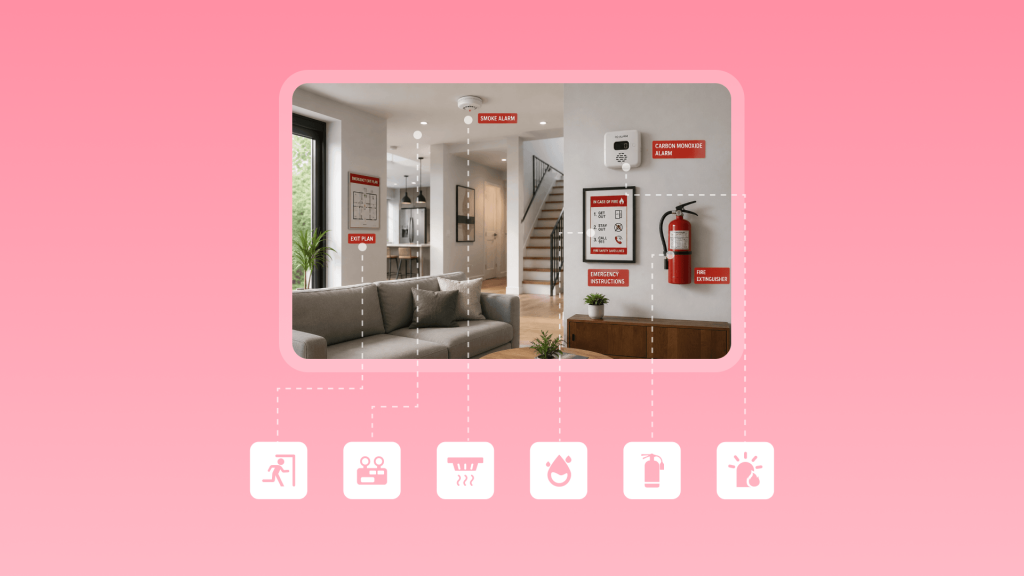
요약:
Fire safety compliance is no longer optional for short-term rental hosts. Across the US, many cities and states now require smoke alarms, carbon monoxide detectors, emergency egress access, and other safety measures for Airbnb and vacation rental properties.
At a minimum, most STR hosts should ensure:
- Smoke alarms are installed inside bedrooms and on every level
- Carbon monoxide detectors are installed where required
- Fire extinguishers are accessible and properly maintained
- Emergency exits remain clear and code-compliant
- Guests receive clear fire safety instructions
- Safety inspections and testing records are documented
Local laws vary widely, and some jurisdictions impose stricter requirements for licensed short-term rentals. Non-compliance can lead to fines, permit issues, insurance complications, or listing suspension.
Airbnb 운영을 간소화할 쉬운 방법을 찾고 있다면 다음을 고려해 보세요. 호텍스. 이 솔루션은 70% 이상의 일일 단기 임대 업무를 단 $4.9/월의 비용으로 자동화하여 가장 중요한 업무에 집중할 수 있는 시간을 더 많이 제공합니다.

The short-term rental industry has expanded rapidly over the past few years, but fire safety expectations have also become more serious. For Airbnb and vacation rental hosts, this means fire safety is no longer just a checklist item, but part of day-to-day operational responsibility.
Understanding what is actually required and how different rules apply across jurisdictions can help prevent costly mistakes and avoid unnecessary risk.
This guide breaks down the key fire safety requirements for short-term rental properties in 2026, so you can operate with more clarity and confidence.
Smoke Detector Requirements: NFPA 72 and Beyond
The National Fire Protection Association publishes NFPA 72, the National Fire Alarm and Signaling Code. While NFPA standards are not laws by themselves, many states and local jurisdictions adopt them fully or partially into their building and fire codes. For short-term rental hosts, NFPA 72 is often the baseline standard used when evaluating fire safety compliance.
For the latest code information, refer to the official NFPA 72 overview.
Minimum Placement Rules
In most jurisdictions, smoke alarms should be installed:
- Inside every bedroom. Not just in the hallway outside.
- Outside each separate sleeping area, typically within 21 feet of bedroom doors.
- On every level of the home, including basements and habitable attics.
That means even a basement with no sleeping area may still require a smoke alarm under local code.
Interconnection Requirements
Many modern building codes based on NFPA 72 require smoke alarms to be interconnected. When one alarm sounds, all alarms sound throughout the property. This is especially important in larger vacation rentals or multi-level STR properties where guests may not hear a single alarm.
Interconnection can usually be achieved through:
- Hardwired systems with battery backup, commonly required in new construction and major renovations
- Wireless interconnected alarms using radio frequency (RF) technology, which are often permitted in existing homes
However, local requirements vary. Always verify with your city or county building department.
Power Source Requirements
For newer homes and renovated properties, hardwired smoke alarms with battery backup are commonly required.
In many existing residential properties, 10-year sealed lithium battery smoke alarms are generally accepted. However, some jurisdictions still require hardwired systems, especially for licensed short-term rentals.
Testing and Replacement
Smoke alarms only help if they work properly. Hosts should build regular testing into their vacation rental maintenance routine.
Best practices include:
- Test all smoke alarms monthly
- Keep a written or digital testing log
- Replace alarms according to the manufacturer’s instructions, typically every 10 years from the manufacturer’s date
- Replace any unit immediately if it fails testing or chirps repeatedly
그만큼 US Consumer Product Safety Commission’s smoke alarm guide is also a helpful reference for hosts.
State-Specific Smoke Detector Laws
Some states impose additional smoke alarm requirements beyond commonly adopted NFPA standards. Local STR ordinances may also add stricter rules for Airbnb and vacation rental properties.
| State | Additional Requirements |
|---|---|
| California | Smoke alarms must meet state approval requirements. Many residential properties also require carbon monoxide alarms. |
| New York | New York City requires smoke and carbon monoxide alarm compliance under Local Law 112 and Local Law 113. |
| Florida | Smoke alarms are generally required in sleeping rooms and on each level in newer construction. |
| Texas | Rental property owners must install smoke alarms according to state property code requirements. |
| Illinois | Smoke alarms must comply with the Illinois Smoke Detector Act, including specific placement rules near sleeping areas. |
Because state and city requirements change regularly, hosts should always confirm current rules with their local fire marshal or building department before listing a property.
Carbon Monoxide Detector Requirements
Carbon monoxide (CO) is odorless, colorless, and potentially deadly. According to the U.S. Consumer Product Safety Commission, carbon monoxide poisoning causes hundreds of deaths and thousands of emergency room visits in the US each year. For short-term rental hosts, CO detection is a critical part of fire safety compliance.
Most jurisdictions require carbon monoxide detectors if the property has any of the following:
- Gas, oil, or wood-burning appliances, including furnaces, stoves, fireplaces, or water heaters
- An attached garage
- A gas or wood-burning fireplace
For additional guidance, see the CPSC carbon monoxide safety guide.
Placement Rules
Carbon monoxide alarm placement rules vary by jurisdiction, but common requirements include:
- Outside each separate sleeping area, often within 10 to 15 feet of bedroom doors
- On every level of the home, including basements
- Away from fuel-burning appliances and cooking areas to help reduce nuisance alarms
Some states and municipalities also impose specific placement rules for Airbnb and vacation rental properties, especially in licensed STR markets.
CO Detector Standards
Carbon monoxide alarms should meet recognized safety certification standards, including:
- UL 2034
- CSA 6.19
Hosts should also:
- Replace detectors according to the manufacturer’s guidelines, typically every 5 to 7 years
- Check manufacture dates regularly
- Test alarms monthly as part of routine STR maintenance
Combination smoke and carbon monoxide alarms are permitted in many jurisdictions, but local rules may vary.
States with Mandatory CO Detector Laws for Rentals
Many states now require carbon monoxide alarms in residential rental properties, especially where fuel-burning appliances or attached garages are present.
Examples include:
| State | Key Requirement |
|---|---|
| California | CO alarms are required in dwelling units with fossil fuel appliances or attached garages |
| New York | CO alarms are required in residential rental units, including many short-term rentals |
| Illinois | CO alarms are generally required within 15 feet of sleeping areas |
| Massachusetts | CO alarms are required on habitable levels in many residential properties |
| Minnesota | CO alarms are required near sleeping areas in residential dwellings |
Requirements can differ significantly between states, counties, and cities. Some local governments impose stricter fire safety rules for vacation rentals than standard residential housing. Always confirm current requirements with your local fire marshal or building department before accepting guests.
Fire Extinguisher Requirements for Short-Term Rentals
Federal law generally does not require fire extinguishers in single-family rental homes. However, many local fire codes, short-term rental ordinances, insurance providers, and vacation rental licensing programs do.
Even when not legally required, fire extinguishers are considered a basic fire safety measure for Airbnb and vacation rental properties.
What Type of Fire Extinguisher Do You Need?
For most short-term rentals, a multipurpose Class ABC fire extinguisher is the recommended choice. These extinguishers are designed to handle:
- Ordinary combustible fires
- Flammable liquid fires
- Electrical fires
A minimum rating of 2A:10B:C is commonly recommended for residential use. In most homes, a 5-pound extinguisher is the standard size for kitchens and common areas.
그만큼 National Fire Protection Association fire extinguisher guide provides additional homeowner guidance.
Where to Place Fire Extinguishers
Placement matters just as much as having the extinguisher itself.
Best practices for vacation rentals include:
- Kitchen: Place the extinguisher within easy reach, but not directly beside the stove. Guests should be able to access it without moving toward the fire.
- Each floor: Keep at least one extinguisher on every level, ideally near an exit path or stairwell.
- Larger layouts: If guests need to travel a long distance from a bedroom to reach an extinguisher, consider installing additional units near sleeping areas.
In larger STR properties, local code may specify maximum travel distances.
Maintenance Requirements
A neglected fire extinguisher may fail when guests need it most. Hosts should include extinguisher checks in their regular property maintenance routine.
Recommended practices include:
- Inspect monthly for visible damage, pressure level, and intact safety seals
- Arrange professional servicing if required by local code or manufacturer guidance
- Recharge or replace the extinguisher after any use, even partial discharge
- Follow the manufacturer’s replacement recommendations and expiration guidance
Some extinguishers remain serviceable for many years if properly maintained, so avoid relying on a fixed replacement timeline alone.
Platform and Insurance Expectations
Airbnb strongly encourages hosts to provide fire extinguishers as part of a safe guest environment. Vrbo also expects hosts to comply with all applicable local safety requirements.
In addition, several vacation rental insurance providers, including Proper Insurance and CBIZ, may consider fire safety equipment when evaluating claims or underwriting STR coverage.
For hosts, a properly placed and maintained extinguisher is a low-cost safety upgrade that can help reduce both property damage and liability exposure.
Emergency Exits and Escape Routes
Guests staying in an unfamiliar short-term rental may only have seconds to react during a fire emergency. Clear and accessible escape routes are a critical part of fire safety compliance for any Airbnb or vacation rental property.
Bedroom Egress Requirements
In most residential building codes, bedrooms must provide at least two escape routes during an emergency. This is commonly achieved through:
- A bedroom door
- An operable emergency escape window
그만큼 International Residential Code egress requirements overview outlines common standards used in many US jurisdictions.
Typical egress window requirements include:
- Minimum clear opening area of 5.7 square feet
- Minimum opening height of 24 inches
- Minimum opening width of 20 inches
- Window sill height no higher than 44 inches from the floor
If bedroom windows have security bars or grilles, they should include a quick-release mechanism that can be opened from inside without keys, tools, or special knowledge.
Local requirements may vary, especially in older buildings or historic properties.
Keep Exit Paths Clear
A compliant exit route should remain accessible at all times.
Hosts should avoid:
- Blocking doors or hallways with furniture, storage items, or decor
- Using locks that require a key to exit from inside
- Restricting access to stairwells or exterior doors
In many jurisdictions, exit doors on rental properties must allow occupants to leave quickly without a key or special tool.
For vacation rentals, clear exit paths are especially important because guests are unfamiliar with the property’s layout.
Multi-Story Property Safety
For upper-floor bedrooms without direct exterior stair access, fire escape ladders can provide an additional layer of safety.
Best practices include:
- Providing escape ladders for second-story or higher sleeping areas when appropriate
- Choosing ladders rated for the correct height and weight capacity
- Storing ladders near emergency egress windows
- Mentioning their location in your guest safety instructions
While not always legally required in single-family STRs, they are commonly recommended for larger homes and family-oriented vacation rentals.
Emergency Lighting
Power outages can make evacuation more difficult during a fire emergency. Battery-backed or plug-in emergency lighting can help guests safely navigate hallways, stairwells, and exit paths.
Although emergency lighting is not typically required in most single-family short-term rentals, it is strongly recommended for:
- Large properties
- Multi-level homes
- Cabins or rural vacation rentals
- Properties with complex layouts or narrow stairways
Small fire safety upgrades, like emergency lighting, can significantly improve guest safety during nighttime emergencies.
Fire Safety Instructions and Guest Communication
Having the right fire safety equipment is only part of the job. Guests also need to know where safety devices are located and what to do during an emergency. Clear communication helps reduce confusion, improves guest safety, and creates a documented record that you provided important information.
What Safety Information Should Hosts Provide?
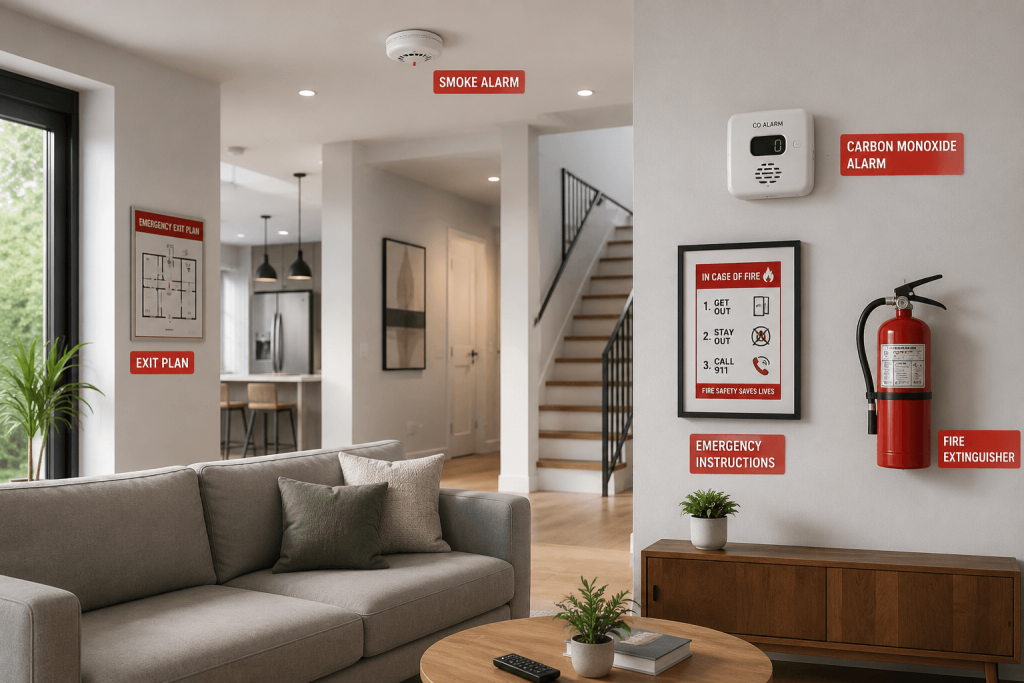
Short-term rental hosts should post basic fire safety instructions in a visible location, such as:
- Near the main entrance
- In the kitchen
- Inside a guest information binder
Your safety instructions should include:
- Locations of smoke alarms and carbon monoxide detectors
- Locations of fire extinguishers
- Emergency exit routes
- Emergency phone numbers, including 911 and local emergency services
- Utility shutoff locations, such as gas, water, and electrical panels
- Emergency contact information for the host or property manager
It is also smart to include basic house rules related to fire safety, including:
- No unattended candles
- No indoor grilling or open flames
- No tampering with smoke alarms or CO detectors
For larger vacation rentals, a simple evacuation diagram can also help guests understand exit routes more quickly.
Digital Safety Information for Airbnb and Vrbo Guests
Airbnb allows hosts to share safety information directly through the listing and guest communication system. Vrbo offers similar features for vacation rental hosts.
Whenever possible:
- Upload a digital safety guide or house manual
- Include fire safety instructions in pre-arrival messages
- Remind guests where emergency equipment is located after check-in
This also creates a documented record showing that you communicated important safety information to guests. That documentation may prove valuable if an insurance claim, liability dispute, or platform investigation arises.
Why Fire Safety Compliance Matters for Insurance
Many short-term rental hosts focus on guest experience and overlook the insurance side of fire safety compliance. However, after a fire or carbon monoxide incident, insurance companies often investigate whether the property met basic safety requirements and local code standards.
If serious safety violations are discovered, the financial consequences can be significant.
Potential risks may include:
- Reduced or denied insurance coverage for property damage or liability claims
- Increased personal liability exposure if guest injuries occur
- Problems with platform support or reimbursement programs after a safety-related incident
For example, platforms like Airbnb and Vrbo expect hosts to maintain safe and accurately represented properties. Missing or non-functional safety equipment may complicate claims reviews or investigations following an incident.
What Insurers Commonly Check After a Fire
After a fire or smoke-related claim, insurers and investigators may review whether:
- Smoke alarms were properly installed and operational
- Carbon monoxide detectors were installed where required
- Fire extinguishers were accessible and properly maintained
- Exit paths and egress windows were unobstructed
- Safety inspections or detector testing had been documented
- Guests received basic fire safety instructions
Even small oversights can become major issues during a liability investigation. For short-term rental hosts, maintaining clear safety records is often just as important as installing the equipment itself.
Short-Term Rental Fire Safety Rules Vary by State and City in the US
Fire safety requirements for short-term rentals can differ significantly across the US. In many cases, local STR ordinances and city licensing programs impose stricter rules than statewide residential codes.
The table below provides a general overview of common fire safety requirements in several major vacation rental markets. However, hosts should always verify current regulations with local authorities before relying on statewide guidance alone.
| State | Smoke Alarms | CO Alarms | Fire Extinguishers | Common STR Compliance Requirements |
|---|---|---|---|---|
| California | Commonly required | Commonly required | Often recommended | Many cities require STR permit safety verification |
| Florida | Commonly required | Often required in newer homes or fuel-burning properties | Required in some jurisdictions | Some counties and cities require fire inspections for STR licenses |
| New York | Required in most residential rentals | Commonly required | Often required in larger buildings | NYC imposes additional detector and safety documentation rules |
| Texas | Required in rental properties | Varies by city and property type | Often recommended | STR regulations differ widely by municipality |
| Tennessee | Commonly required | Commonly required | Required in some STR markets | Nashville requires safety-related STR inspections |
| Colorado | Commonly required | Commonly required | Often recommended | Mountain resort towns may require evacuation or safety plans |
| North Carolina | Required in residential rentals | Commonly required | May be required for larger properties | Some jurisdictions require inspections for higher occupancy rentals |
| Hawaii | Commonly required | Commonly required | Often required | Some counties require fire safety documentation for STR permits |
Because local rules change frequently, hosts should confirm current requirements directly with:
- Local fire marshal offices
- Building departments
- STR licensing agencies
- Official municipal websites
그만큼 National Fire Protection Association website and local government resources are good starting points for researching updated fire safety requirements.
FAQs about Short-Term Rental Fire Safety
Do I need a fire sprinkler system in my short-term rental?
Most single-family short-term rentals in the US are not required to install residential fire sprinkler systems. However, some cities and counties impose stricter fire safety rules for:
- Multi-unit buildings
- Large vacation rentals
- High-occupancy STR properties
- Newly constructed homes
Certain jurisdictions may also require sprinkler systems as part of STR licensing or permit approval. Because local regulations vary widely, hosts should confirm requirements directly with their building department or fire marshal before assuming an exemption applies.
Can I use battery-operated smoke alarms, or do I need hardwired units?
That depends on your property’s age, renovation history, and local code requirements.
In many jurisdictions:
- New construction and major renovations require hard-wired smoke alarms with battery backup
- Existing homes may use sealed 10-year battery smoke alarms if permitted by local code
Wireless interconnected alarms are also accepted in many areas for retrofit installations. However, requirements differ by state and municipality, especially for licensed Airbnb and vacation rental properties.
For current guidance, hosts should always verify requirements with local authorities.
What should I do if a guest disables a smoke alarm?
Guest tampering with fire safety equipment should be addressed immediately.
If you discover that a smoke alarm or CO detector has been removed, disconnected, or disabled:
- Document the issue with photos and timestamps
- Replace or reactivate the unit before the next guest checks in
- Report the issue through the booking platform if necessary
- Remind guests that tampering with safety devices violates house rules
Many hosts also include smoke alarm tampering policies in their rental agreement or guest handbook. Keeping written records can help protect you during disputes, insurance claims, or platform investigations.
Is a fire safety inspection required for short-term rentals?
Some cities and counties require fire safety inspections before issuing or renewing a short-term rental license. Inspection requirements are more common in:
- High-tourism cities
- Large occupancy vacation rentals
- Multi-unit STR buildings
- Mountain and wildfire-prone regions
Even where inspections are not legally required, periodic inspections can help hosts identify hazards early and maintain documentation for insurance purposes.
Do Airbnb or Vrbo require fire extinguishers?
Airbnb and Vrbo both expect hosts to provide safe accommodations and comply with local laws. Smoke alarms and carbon monoxide detectors are commonly required safety disclosures on listings.
Fire extinguisher requirements, however, usually depend on local regulations and property type. Even when not legally required, many hosts and insurance providers consider fire extinguishers a basic vacation rental safety measure.
What if my state does not require carbon monoxide detectors?
State law is only part of the picture. Many counties and cities impose stricter CO detector rules than statewide residential codes, especially for short-term rentals.
Even when carbon monoxide alarms are not explicitly required, installing them is strongly recommended for any property with:
- Fuel-burning appliances
- Fireplaces
- Attached garages
Carbon monoxide is impossible to detect without an alarm. For most hosts, the cost of installing detectors is minimal compared to the potential safety and liability risks of a CO poisoning incident.
How often should I test smoke alarms and CO detectors?
Most manufacturers and fire safety organizations recommend testing smoke alarms and carbon monoxide detectors at least once per month.
Hosts should also:
- Test alarms after battery replacement
- Check devices between guest stays
- Replace units according to manufacturer guidelines
- Keep a written or digital maintenance log
For short-term rental operators managing multiple properties, documenting routine testing can also help support insurance records and compliance documentation.
Can I use combination smoke and carbon monoxide alarms in my Airbnb?
Yes. Combination smoke and carbon monoxide alarms are permitted in many jurisdictions and are commonly used in short-term rentals to simplify installation and maintenance.
However, hosts should still verify:
- Proper placement requirements
- Local code restrictions
- Certification standards
- Interconnection requirements are applicable
Some jurisdictions may still require separate devices in specific locations.
Are smart smoke detectors worth it for vacation rentals?
Smart smoke alarms can provide additional protection for Airbnb and vacation rental hosts because they send mobile alerts when alarms are triggered or when devices lose power.
For hosts managing remote properties or multiple STR units, smart alarms may help:
- Detect problems faster
- Reduce maintenance oversight
- Monitor battery status remotely
- Respond more quickly to emergencies
However, smart devices should never replace local code compliance or regular in-person testing.
Final Fire Safety Checklist for Short-Term Rental Hosts 2026
Use this fire safety checklist before guest arrivals and during routine property inspections. Keeping a written or digital record can also help support insurance documentation and STR compliance reviews.
Smoke Alarms
- Smoke alarms are installed inside every bedroom
- Smoke alarms installed outside sleeping areas
- Smoke alarms are installed on every level of the property, including basements
- Interconnected alarms are functioning properly, where required by local code
- Battery backup is working correctly
- All alarms are tested regularly and are fully operational
- No alarm past the manufacturer’s recommended replacement date
Carbon Monoxide Detectors
- CO alarms are installed near sleeping areas where required
- CO alarms installed on each required floor level
- Detectors certified to recognized safety standards such as UL 2034 or CSA 6.19
- Units are tested regularly and are functioning properly
- No detector past the manufacturer’s recommended replacement date
Fire Extinguishers
- At least one Class ABC fire extinguisher available
- Fire extinguisher placed in or near the kitchen
- Additional extinguishers available on larger or multi-level properties if needed
- Pressure gauge in safe operating range
- Safety seal intact
- Unit inspected and maintained according to manufacturer guidance
Emergency Exits and Escape Routes
- Bedrooms have compliant emergency egress access where required
- Exit windows open properly and remain unobstructed
- Hallways, stairwells, and exit doors remain clear
- Guests can unlock exit doors from inside without special tools or keys
- Fire escape ladders available for upper-floor sleeping areas if appropriate
Guest Safety Information
- Fire safety instructions are posted in a visible location
- Emergency contact information shared with guests
- Utility shutoff locations documented
- House rules include basic fire safety guidance
- Digital safety information uploaded to Airbnb or Vrbo listings, if applicable
- Detector testing and maintenance records are maintained
Insurance and Compliance
- STR use disclosed to your insurance provider
- Property reviewed for local fire safety compliance requirements
- Required inspections or permits completed where applicable


 Korean
  English
  Japanese
  Spanish
  Arabic
  French
  Russian
  German
  Portuguese
  Italian
  Thai
Thai