

Setting clear Airbnb house rules is one of the smartest moves a host can make, especially for those just starting out. Well-written rules are a key part of guest communication, helping prevent misunderstandings and property damage while setting clear expectations for guests.
In this guide, we’ll explain why Airbnb house rules matter, what to include, and how to set them up effectively. You’ll also find a free, customizable template that you can adapt to your own property.
Airbnb policy update: The updated house rules and requests policy applies to reservations booked on or after November 20, 2026. Use the booking date, not the arrival date, to determine which policy applies.
What Are Airbnb House Rules?
Airbnb house rules refer to a set of guidelines and expectations that hosts establish for their guests to ensure a positive and harmonious experience.
These rules cover core expectations such as noise, smoking, pets, and overnight guest limits. Airbnb now distinguishes standard house rules from additional requests: guests must follow house rules and are encouraged to comply with reasonable requests. Use the designated listing fields for each, rather than treating every instruction in a house manual as an enforceable rule.
The Importance of Airbnb House Rules
- Clear Expectations: Airbnb house rules provide clarity to both hosts and guests regarding what is acceptable behavior during the stay. By clearly defining the expectations upfront, hosts can avoid potential misunderstandings or conflicts.
- Property Protection: Instructions for amenities, appliances, and common areas help guests use the space responsibly and reduce avoidable damage.
- Guest Safety: Clear safety information helps guests understand equipment and find emergency instructions. A rule does not replace the host’s responsibility to maintain a safe property.
- Respect for Neighbors and Local Requirements: Quiet hours and relevant building or local requirements help guests understand how their stay affects the surrounding community. Disclose qualifying local rules in Airbnb’s designated local-rules section.
How Can I Set Up Airbnb House Rules?
Setting up Airbnb house rules is quite a straightforward process. By establishing these rules, clear guidelines and protections can be provided for both guests and Airbnb hosts.
1. Setting House Rules on Airbnb:
Publish your rules before guests book so they can decide whether the property suits their stay. Keep standard house rules separate from additional requests, and make sure both comply with Airbnb’s policies.
It’s simple to do this by following the steps:
- Open Listings and select your property.
- Under Listing editor, choose House rules and requests.
- Add or edit the standard house rules, then save.
- Under Requests, add reasonable instructions for during the stay or before checkout, then save.
See Airbnb’s current setup instructions for the available fields.
Additional requests must also be visible in the designated section when guests book. A check-in guide or printed sign can repeat the published information, but cannot introduce new rules or requests after booking.
2. Setting House Rules for Check-ins:
Once guests arrive at your property, make the same published information easy to find. You can do this by:
- Printing out a copy of the house rules and placing it in a visible location within the property.
- Adding a link to your Guidebook allows guests to access and review the rules conveniently on their phones.
Remember, while it’s essential to establish clear house rules, it’s also important to maintain a friendly and pleasant tone. By striking a balance between professionalism and a friendly approach, you can promote a positive atmosphere and encourage guests to respect and follow the rules.
15 Most Important Airbnb House Rules
The following 15 examples cover common hosting situations. Use standard settings where Airbnb provides them, and treat the remaining items as possible requests or practical information. Choose only what is relevant and reasonable for your property; a template is a starting point, not a list of obligations for every guest.
1. No Smoking Indoors
Smoking indoors can leave behind unpleasant odors and potentially damage the furniture. This can significantly impact the experience of future guests. Therefore, it is crucial to clearly state in your house rules that smoking is not allowed inside the property. If you have designated outdoor smoking areas, make sure to mention them and instruct guests to properly dispose of cigarette butts.
2. No Parties or Events
To promote a peaceful and relaxing atmosphere, it’s recommended to avoid hosting parties or events at the property. Unauthorized parties or events can cause chaos, upset the neighbors, and potentially turn your place into a scene from a college movie.
3. Quiet Hours
As an Airbnb host, you’re probably aware that one of the most common reasons for neighbor complaints is noise during nighttime hours. To avoid any conflicts with neighbors and ensure that all guests can have a good night’s rest, it’s best to establish clear Quiet Hours in your Airbnb house rules. Typically, these hours are during the late evening and early morning.
4. Pet Policy
Use Airbnb’s pet setting to state whether you welcome pets and any applicable limits. A no-pets setting does not override Airbnb’s accessibility policy for service animals or, where applicable, emotional support animals. Do not promise an allergen-free home simply because ordinary pets are not accepted.
5. Check-In and Check-Out Times
Establish clear check-in and check-out times that leave sufficient room for cleaning and preparation between guests. If you offer a choice within an arrival window, make that clear in the check-in guide. Guests should request a different time before assuming early entry or late checkout is available.
6. Proper Waste Disposal
Provide clear information about indoor bins and any local sorting requirements. Under the updated policy, taking trash off-site should not be a standard checkout task. Airbnb may consider exceptions based on local conditions, such as disposal in an animal-proof container in bear country; confirm the relevant circumstances rather than applying an exception to every property.
7. Damage and Breakage Policy
Accidents happen, and they are sometimes unavoidable. Ask guests to report damage or breakages promptly so you can address a hazard or arrange a repair. For reimbursement, document the actual loss and use Airbnb’s Resolution Center. Do not impose a fixed violation fine or assume that a house rule authorizes an automatic security-deposit deduction.
8. Overnight Guests and Visitors
Set the maximum overnight guest count in the standard rule settings. Ask guests to discuss additional overnight guests and update the reservation where appropriate. If you need daytime visitor limits, add a reasonable request; a visitor and an additional overnight guest are not automatically the same thing.
9. Parking Guidelines:
If parking is available, provide clear guidelines to guests regarding parking regulations and available spaces. This will help prevent any parking-related issues or conflicts, ensuring a smooth and hassle-free experience for all.
10. Prohibited Items
Communicate any prohibited items or activities to guests to ensure their safety and the integrity of the property. This may include items such as illegal substances, firearms, or flammable materials. By setting clear boundaries, you can maintain a secure and comfortable environment for all.
11. Fire Safety
Promote fire safety by providing information on the location of fire extinguishers and emergency exits. Encourage guests to familiarize themselves with fire safety procedures and emphasize the importance of vigilance. This will help create a safe environment for all guests.
12. No Eating or Drinking in Bedrooms
Food and drinks can stain bedding or carpets, so you may want to ask guests to eat in the dining area. Present this as a reasonable property-specific request in the designated field, rather than a universal Airbnb rule with a fine attached.
13. Kitchen Ventilation
If cooking smells linger in your property, explain how to use the extractor fan or other ventilation. Practical guidance is more useful than a broad ban on particular foods or cuisines, and guests must be able to use the kitchen you advertise.
14. Turn Off Appliances When Going Out
You can remind guests to turn off lights and suitable appliances when leaving. Identify the relevant controls and leave out equipment that needs to stay on, such as the refrigerator. Do not use an energy-saving request to deny guests access to advertised heating or air conditioning.
15. No Furniture Rearrangement
As an Airbnb host, you invest time and effort in arranging your property. A short request to leave heavy furniture in place can help avoid damage or blocked exits. Keep it reasonable, publish it before booking, and avoid turning checkout into a furniture-moving task.
Airbnb House Rules Template for Easy Implementation
Use the editable Airbnb house rules template below as a starting point. Fill in your property details and publish each item in the appropriate Airbnb field before using the same wording in a printed reminder or Hostex check-in guide.
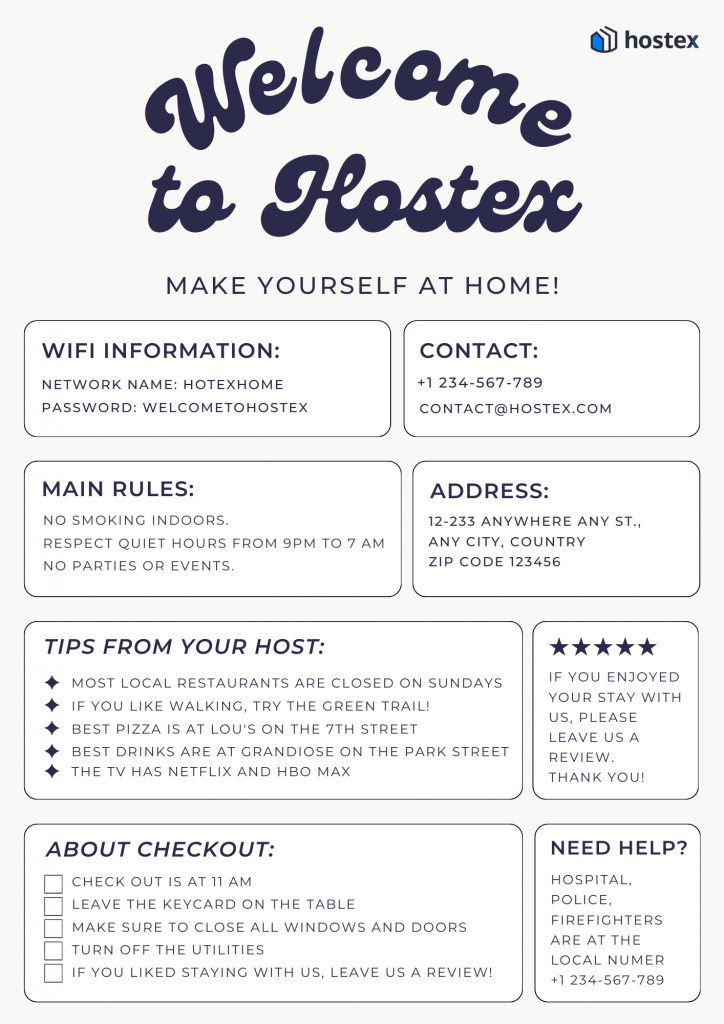

Template 1: Standard House Rules
- Maximum overnight guests: [number].
- Quiet hours: [start]–[end].
- Events: [setting, subject to Airbnb’s disruptive-gatherings policy].
- Pets: [setting and limits, subject to accessibility requirements].
- Smoking and vaping: [setting and permitted location, if any].
- Commercial photography and filming: [setting].
- Lock up at checkout: [setting and key-return instructions].
Template 2: Additional Requests
Please use [bin locations] for trash and recycling. Before checkout, please leave used towels in [location] and used dishes in [location]; our cleaners handle the linen change and washing up. Please park in [space]. If you notice damage or a maintenance problem, message us through your reservation.
These examples do not cover every setting Airbnb offers. Add only requests that suit your property, and do not attach fines for failing to complete them.
Hostex can help deliver your published guest information through automated messages and a check-in guide. Keep these reminders aligned with the wording guests saw when booking.

 English
 Japanese
 Spanish
 Arabic
 French
 Russian
 German
 Portuguese
 Korean
 Italian
 Thai
My brother recommended I might like ths blog. He was totally right.
Thanks!
👌🏻
Thank you so much for sharing.
Thanks for breaking it down so clearly.
Fantastic insights!
like this onw
Thank you for sharing
ich finde airbnb inzwischen einfach obsolet. ich brauche nur ein bett, ein einfaches bett und eine steckdose. ich brauche meinen schlaf sonst muss ich fr. vasileva wieder besuchen. mehr als 10 € für ein bett ist einfach lächerlich. soviel hatte ich 2017 gezahlt, nachdem ich auf couchsurfing nur beleidigungen abbekommen hatte. 2022 juni wurde ich anhand meiner behördlichen identität (perso, pass) gesperrt, weil ich der beste gastgeber und gast war. das passte dem unternehmen nicht. ich kann nicht mal mehr buchen und will airbnb auch garnicht mehr ertragen müssen. ich fühle mich seit 2012 von dem unternehmen und der berichterstattung genervt. 2017 gab ich eine chance, 2021 half man mir wieder. ich sagte mir, das unternehmen ist vielleicht doch nicht so übel. weit gefehlt!
Thank you so much! A great help!
How do i customize this template?