

A mediados de agosto de 2025, Airbnb realizó un cambio significativo en su estructura de tarifas, which initiated widespread discussions across social media and the Airbnb host community. Many hosts are concerned that these changes could negatively impact their profits. Key questions being raised include:
- ¿El aumento de la tarifa afectará las tasas de reserva y la rentabilidad general?
- ¿Airbnb está aplicando esta nueva estructura de tarifa única en todos los anuncios?
- ¿La tarifa única beneficia o perjudica a los anfitriones y cómo elegir?
¿Son válidas estas preocupaciones? Analicemos en detalle la última política de comisiones de Airbnb.
¿Cuál es la última política de tarifas de Airbnb?
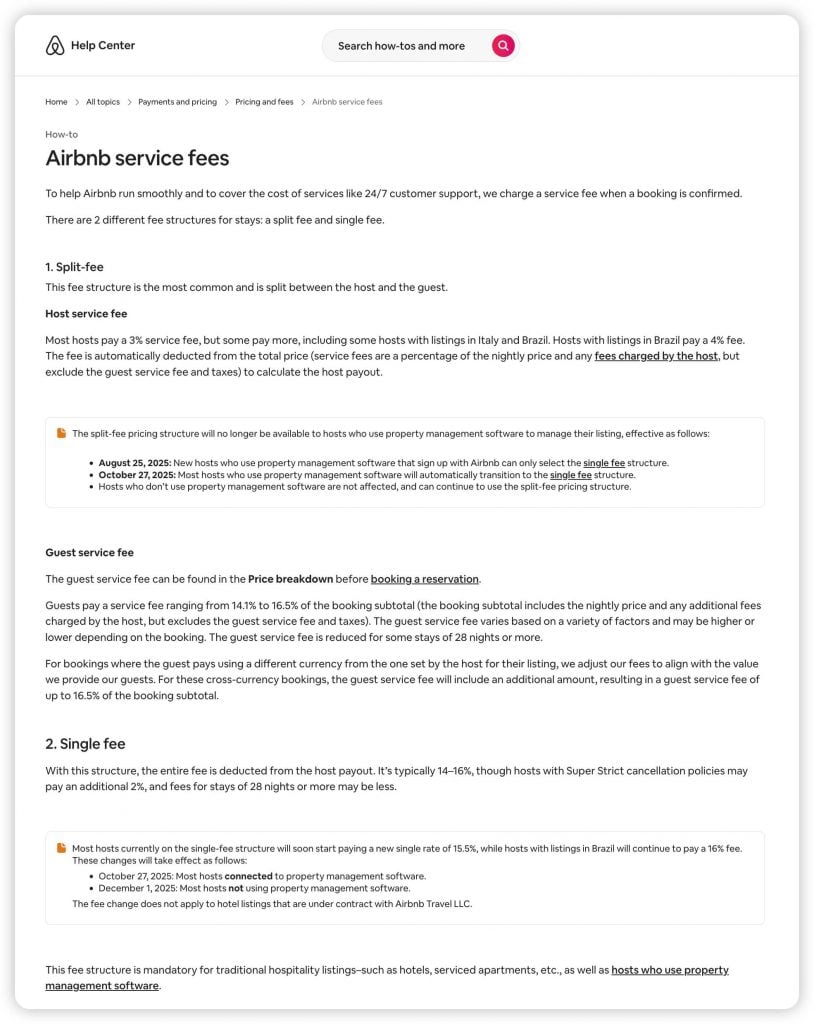
Airbnb charges a service fee on nearly every booking. In 2025, the platform renamed its host-only structure the “single fee” and tightened who must use it (Centro de ayuda de Airbnb). Two structures still describe how that fee works.
Tarifa dividida
Under the split model, the cost is split.
The host pays about 3 percent (4 percent in Brazil). The guest pays a separate fee of 14.1–16.5 percent on top of the nightly rate. The guest sees that the guest fee is itemized before they pay.
Tarifa única
Under the single model, one fee comes out of the host payout.
Most hosts pay 15.5 percent. The rest typically pay 14–16 percent, and listings in Brazil and Mexico pay 16 percent. Guests no longer see a separate Airbnb service line at checkout.
Airbnb says the move simplifies pricing because guests see one total instead of a base rate plus a separate charge (Airbnb official update).
What Changed with the Airbnb Single Fee?
1. A New Name
Since 2020, Airbnb offered two structures: split fee and host-only fee. Now, the new single fee replaces the host-only feeEste nuevo término refleja el cambio en cómo se calculan las tarifas y se deducen del pago del anfitrión.
2. Who It Applies To
The single fee is mandatory for traditional hospitality listings such as hotels and serviced apartments. It is also mandatory for hosts who use property management software.
In the past, hosts in the United States, Canada, the Bahamas, Mexico, Argentina, Taiwan, and Uruguay could keep split pricing if they used a PMS. And now, that exception is gone.
3. The Fee Percentage
Los cambios en los porcentajes de tarifas bajo la nueva estructura de tarifas de Airbnb son los siguientes:
- Con la anterior estructura de tarifas exclusivas para anfitriones, estos solían pagar alrededor de 151 TP3T. Esta tarifa ha aumentado ligeramente a 15,51 TP3T con la nueva estructura de tarifas únicas de Airbnb.
- Con la estructura de "tarifa dividida", la mayoría de los proveedores pagaban una tarifa de servicio de entre 3% y 5%. Esta tarifa ahora se ha sustituido por una tarifa fija. 3% Tarifa de servicio para los anfitriones, aunque algunos anfitriones en países como Italia y Brasil aún pueden pagar tarifas más altas.
- The guest service fee used to range between 11% and 12% of the booking subtotal. Now, it has increased to 14.1% to 16.5%.
| Split Fee (old) | Single Fee (current) | |
| Who pays | Host + guest | Host only |
| Host rate | About 3% (4% Brazil) | 15.5% for most; 14–16% rest; 16% Brazil, Mexico |
| Guest rate | 14.1–16.5% at checkout | None shown at checkout |
| Charged on | Nightly + host fees (guest side) | Full subtotal: nightly + cleaning + extras |
| PMS hosts | Could keep split (some countries) | Required |
| Bookings already made | n/a | Keep original structure |
¿Por qué el cambio de tarifas de Airbnb ha generado tanto debate?
1. Un aumento significativo de las tarifas
Con la estructura de tarifa dividida, los huéspedes pagaban una comisión de servicio que oscilaba entre 14,11 TP3T y 16,51 TP3T. Al combinar esta comisión con la parte del anfitrión de 31 TP3T, Airbnb cobraba entre 17,11 TP3T y 19,51 TP3T del total de cada reserva.
Bajo la estructura de tarifa única, los anfitriones pagaban inicialmente 15%, pero ahora esta cantidad ha aumentado a 15,5%.
Este aumento es ciertamente frustrante para los anfitriones, a pesar de que Airbnb ha proporcionado un margen de tiempo para la transición. El aumento de las tarifas afecta directamente las estrategias de precios y la rentabilidad de los anfitriones, e indirectamente la competitividad y las tasas de reserva de sus anuncios.
2. Ambigüedad en el lenguaje
Las nuevas normas de Airbnb parecen ser bastante detalladas y exhaustivas, con un resumen claro de todo lo que los anfitriones deben saber. Sin embargo, algunas explicaciones son vagas y utilizan un lenguaje ambiguo, lo que genera confusión entre muchos anfitriones.
Por ejemplo, Airbnb utiliza con frecuencia el término “la mayoría de los anfitriones”, pero esto plantea una pregunta común: ¿A quién se refiere exactamente "la mayoría de los anfitriones"? Los anfitriones quieren saber: "¿Estoy incluido en el grupo 'la mayoría' o seré excluido?"
De hecho, Airbnb solía usar una terminología similar, lo que puede entenderse como una forma de que la plataforma deje margen de interpretación. Esto les permite gestionar posibles reacciones negativas con mayor eficacia.
Por ejemplo, cuando Airbnb introdujo la tarifa exclusiva para anfitriones en 2020, inicialmente se implementó a nivel mundial. Sin embargo, quizás debido a la fuerte demanda de ciertas regiones, Airbnb tuvo que ofrecer excepciones para anfitriones en países como Estados Unidos, Canadá, Bahamas, México, Argentina, Taiwán y Uruguay.
3. Declaraciones contradictorias
La documentación de Airbnb incluye dos descargos de responsabilidad particulares que han causado confusión entre los anfitriones:
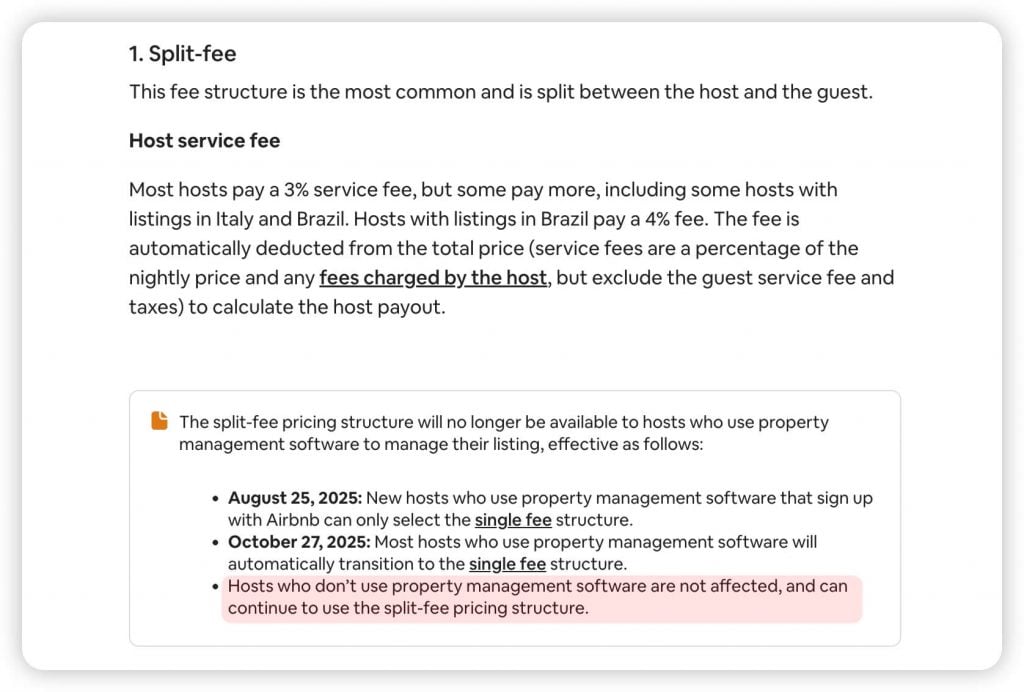
La primera declaración dice: “Los anfitriones que no utilizan software de administración de propiedades no se verán afectados y podrán seguir utilizando la estructura de precios de tarifa dividida."
Sin embargo, la segunda declaración dice: Estos cambios entrarán en vigor para “La mayoría de los anfitriones no utilizarán software de administración de propiedades a partir del 1 de diciembre de 2025."
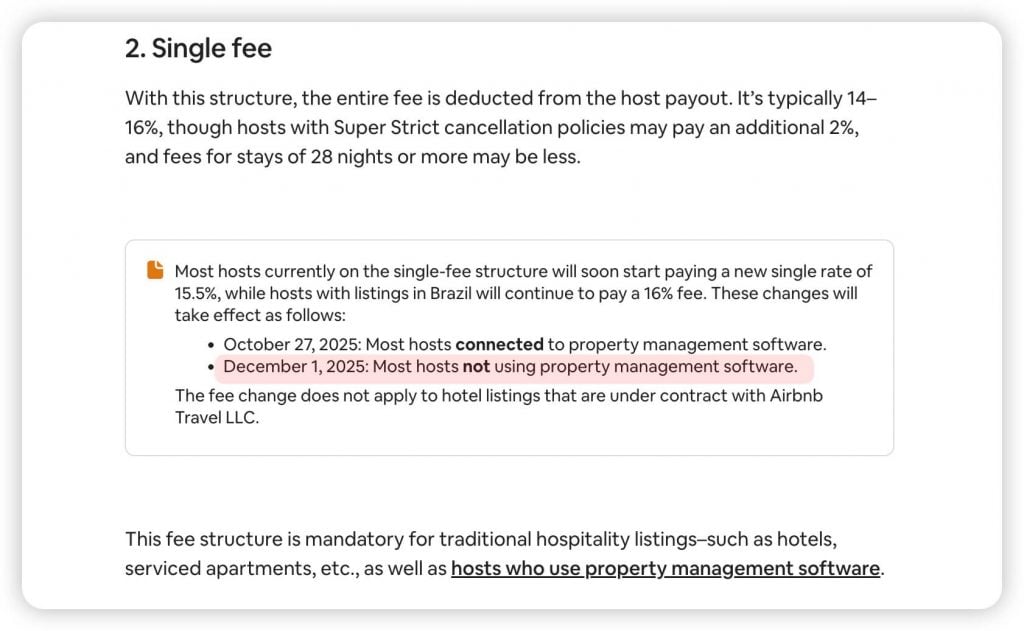
Estas dos afirmaciones parecen contradecirse entre sí, lo que deja a los anfitriones que no utilizan software de administración de propiedades sin saber cuál es la política real.
En realidad, la intención de Airbnb parece quedar clara al principio del segundo párrafo, donde menciona: «La mayoría de los anfitriones que actualmente utilizan la estructura de tarifa única pronto empezarán a pagar una nueva tarifa única». En otras palabras, los anfitriones que anteriormente optaron por la estructura de tarifa exclusiva para el anfitrión, independientemente de si utilizan o no un software de gestión de propiedades, verán su tarifa aumentar a 15,51 TP3T.
Según tengo entendido, Airbnb no está diciendo que todos los anfitriones estarán obligados a cambiar a la estructura de tarifa única a partir del 1 de diciembre de 2025, sino que aquellos que anteriormente usaban la tarifa solo para anfitriones experimentarán el aumento de la tarifa.
How the Single Fee Affects Your Payout
The fee now lands on the whole booking subtotal, including cleaning, pet, and extra-guest fees. Taxes and security deposits are excluded. That changes your math, and it means cleaning fees now carry the 15.5 percent haircut too. Here is a simple example using round numbers.
Say you listed at 100 under the old split model. You kept about 97 after the 3 percent host fee. Under the single fee at the same 100 price, Airbnb deducts 15.5 percent. Your payout becomes about 84.50.
That is roughly a 12–13 percent drop on every future booking, not a one-time hit.
To hold your payout steady, raise your listed price. Moving from 100 to about 115 keeps your take near 97, because 115 minus 15.5 percent equals about $97. Another way to frame it: divide your target payout by 0.845. The result is the listed price you need.
These figures are examples only. Your real rate depends on your location, cancellation policy, and listing type. They are not tax or financial advice.
How to Reprice Your Listings: Step by Step
You do not need to guess. Follow four steps.
Step 1: Check Your Current Fee Structure
Open Airbnb, go to Today, then Menu, then Earnings. Select a reservation and look under Host payout. The host service fee line tells you which structure is active.
Step 2: Use Airbnb’s Price Adjustment Tool
Airbnb built an in-app tool that adjusts prices across all your listings at once. Run it before your deadline so payouts stay level. If you prefer manual control, apply the divide-by-0.845 formula listing by listing. Do not raise prices so high that your listing looks expensive next to your other channels. Reprice with your whole distribution in mind.
Step 3: If You Use a PMS Like Hostex
Hosts who manage listings through Hostex were part of Airbnb’s earliest migration wave. The fee structure follows Airbnb’s PMS rollout, so there is no manual switch to flip. Open your Hostex pricing settings to confirm the rate, then adjust your listed price there. Because Hostex keeps Airbnb pricing in sync with your other connected channels, one reprice updates every channel instead of just one.
Step 4: Re-check Your Payout
After repricing, open a test reservation or the Earnings view and confirm the host payout matches your target. If it is low, nudge the listed price up by another percent or two.
VAT note: In countries that charge VAT on service fees, Airbnb’s tool adds the tax automatically unless you are VAT-registered and self-assess. The guest still sees one clean price.
If you manage more than a few listings, repricing them one by one gets old fast. Hostex runs the whole job from one dashboard that keeps your prices in sync across every connected channel. Its batch editor changes many listings together by a set percentage or a fixed amount, and its price-copy tool brings another OTA’s rate directly into Airbnb when you want the channels to match. Beyond pricing, Hostex automates messaging, guest communication, and day-to-day operations, with plans starting at $4.9 per month.

FAQ about Airbnb Single Fee
When did the Airbnb single fee become mandatory?
The rollout ran in waves from late 2025. The final groups moved on September 15, 2026 (outside the EU) and October 13, 2026 (inside the EU).
What happens if I do nothing?
Your listed price stays the same, but Airbnb deducts 15.5 percent from your payout. Expect roughly 12–13 percent less per booking.
How do I keep my payout the same?
Raise your listed price by about 15 percent, or divide your target payout by 0.845. Airbnb’s price adjustment tool does this across all listings at once.
Does this affect bookings I already accepted?
No. Reservations confirmed before your switch keep the fee structure they were booked under.
I use Hostex. Do I need to change anything?
Your fee structure followed Airbnb’s PMS migration automatically. Confirm the rate in Hostex pricing settings and reprice there so every connected channel stays aligned.
Is the fee charged on my cleaning fee too?
Yes. The 15.5 percent applies to the full booking subtotal, which includes cleaning, pet, and extra-guest fees. Taxes and security deposits are excluded.
Conclusión
Airbnb’s single fee changes more than the percentage deducted from each booking. It can affect your pricing, payouts, and overall profitability, especially if you manage multiple listings or use a PMS. The best approach is to understand which fee structure applies to your listings, adjust your rates based on your target payout, and regularly review your earnings as Airbnb updates its policies.
More broadly, keeping up with vacation rental platform policies is an essential part of running a profitable short-term rental business. Airbnb and other OTAs can change fees, pricing rules, and requirements over time, so staying informed helps you avoid unexpected costs and make better decisions about your distribution strategy.


 Spanish
  English
  Japanese
  Arabic
  French
  Russian
  German
  Portuguese
  Korean
  Italian
  Thai
Thai