
Most vacation rental hosts treat the welcome guide as a nice touch. Something you set up once and forget on the side table.
A clear welcome guide is the difference between a guest who arrives relaxed and one who messages you at 11 p.m. because they cannot find the lockbox. Those small frictions are exactly what show up as “communication” and “check-in” complaints in reviews.
This guide covers what to put in a welcome guide, how to write it so guests actually read it, and how to deliver it to every booking without lifting a finger.
Resumen
- A welcome guide is the one document guests check for check-in and check-out. It cuts repetitive messages and prevents small misunderstandings from turning into 1-star reviews.
- Include: arrival and access, WiFi and devices, reglas de la casa, appliance how-tos, emergency info, local recommendations, and checkout steps.
- Digital beats printed because it updates instantly and reaches guests before they travel. Send it automatically at booking so no stay depends on your memory.
What Is a Vacation Rental Welcome Guide
A welcome guide, also called a guest manual or house manual, is a single document that tells guests everything they need from booking to checkout.
Airbnb’s hosting guidance treats it as two parts in one: a house manual for internet access and appliance use, plus a guidebook for your local tips on where to eat and explore.
It lives in one link the guest opens on their phone. Everything else, from door codes to checkout steps, points back to it.
Why a Welcome Guide Pays Off
A guide is not decoration. It works on three fronts at once, and each protects your rating.
1. Fewer repetitive guest messages
The same five questions arrive before every stay: where do I park, what is the WiFi, how does the heat work, where are the bins, what time is checkout. Put the answers in one link, and those messages stop arriving.
That frees your attention for the guests who actually need a human, instead of answering the same thing on the hundredth repeat.
2. Fewer misunderstandings that become bad reviews
Most 1-star reviews are not about a broken home. They are about a guest who felt lost, ignored, or surprised by a rule they never saw.
A guide removes the “I didn’t know” excuse on both sides. The house rule was stated, the checkout step was clear, and the address was exact, so a bad rating has nowhere to hide.
3. Smoother self check-in
Airbnb encourages hosts to put directions, the house manual, WiFi, and house rules into the listing’s arrival guide, and guests receive that packet ahead of arrival. Guests get their check-in details about 48 hours before the reservation starts.
When your guide delivers all of it cleanly, check-in becomes a non-event instead of a support ticket. A guest who gets inside without a fight starts the stay in a good mood, and mood is what they write about later.
What to Include in Your Welcome Guide
The best guides answer the questions guests ask in the first two hours and the last hour. Cover these sections.
1. Arrival and access
Exact address, the best way to get there, where to park, and how to get inside. If you use self-check-in, spell out the lockbox or smart-lock steps and exactly when the code arrives.
2. WiFi and devices
The network name, password, and any quirk worth flagging, like a 5GHz versus 2.4GHz split or a streaming login. List the devices guests can use, such as the smart TV or sound system, and the one step that turns them on.
3. House rules
Quiet hours, smoking, pets, visitors, and the small things that matter to you, like shoes off indoors. Write them as calm instructions, not a list of threats. Guests follow rules they understand, not ones they fear.
4. Appliance how-tos
The thermostat, the washer, the induction hob, the hot tub. One or two lines each on the non-obvious steps. A photo here beats a paragraph, because guests read images faster than text.
5. Emergency information
Your contact, the local emergency number, the nearest hospital, and what to do for a power cut or a leak. Guests rarely need it, but seeing it builds trust before they ever do.
6. Local recommendations
Where to eat, get coffee, buy groceries, and what to see nearby. This is the part guests remember and the part they mention in reviews, so treat it as hospitality, not filler.
7. Checkout steps
Rubbish and recycling, where to leave keys, and checkout time. Clear steps here prevent the passive-aggressive review about a messy departure, because the guest knew the expectations up front.
How to Write a Welcome Guide Guests Actually Read
A guide nobody opens is a guide that does nothing. These habits change that.
1. Keep it short
One or two lines per item. Guests skim on a phone at the door, not at a desk. If a section needs more, link out instead of padding it with words nobody will read.
2. Use plain words
Write like you talk. “Turn the dial to 22” beats “adjust the ambient temperature setpoint to a comfortable level.” Plain words get followed; jargon gets ignored.
3. Add photos for the tricky bits
The lockbox lid, the breaker switch, the hob that needs a press-and-hold. A single photo ends ten “how do I” messages, because the guest sees the exact thing they are touching.
4. Write for non-native speakers
Many guests book in a language other than yours. Short sentences and clear photos travel better than clever copy. If your tool translates, turn it on so the guide reads right for everyone.
How to Deliver the Welcome Guide Automatically
A guide only helps if it reaches every guest on every booking. Manual forwarding fails the moment you are busy, asleep, or already managing another arrival.
A sistema de gestión de propiedades removes that dependency by turning guide delivery into a workflow that runs on its own.
One link, sent the moment a booking is confirmed
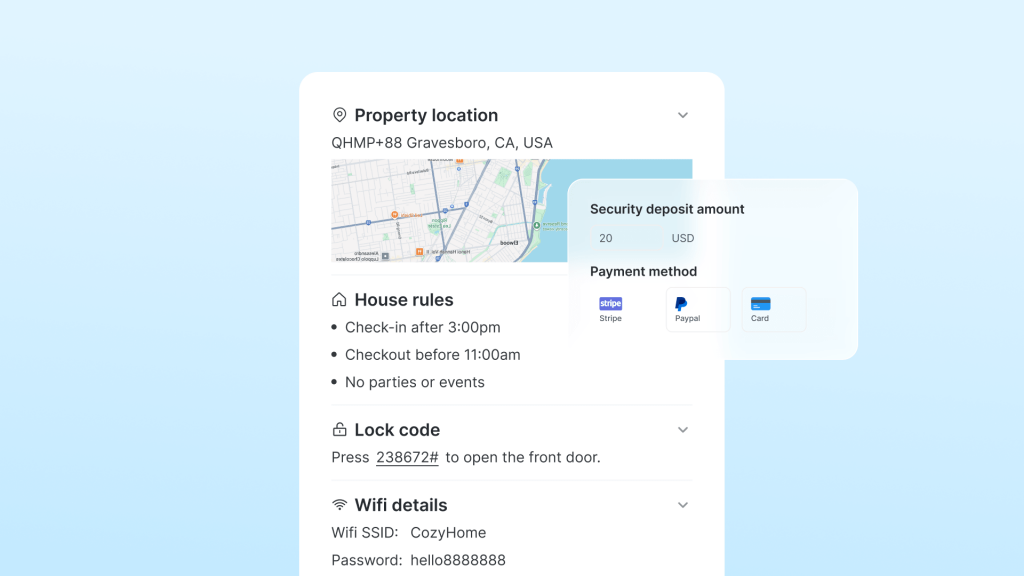
De Hostex guest portal is a self-check-in guide you build once per property. It holds the address with map navigation, WiFi, house rules, and auto-generated door codes, then delivers all of it through a single link.
You drop a shortcode into your automated messages, and the guide link goes out to each guest on its own. No copy-paste, no “did I send it” panic at the end of a long day.
Collect the details and the deposit up front
Before arrival, the guest portal gathers arrival time, guest count, and ID upload or verification, so you are not chasing the basics by email the night before.
It also collects a security deposit per property through your Stripe account, and guests must pay it before check-in. If no damage is found, the deposit is refunded automatically. That protects the home and replaces the awkward “please send a deposit” message with a quiet, built-in step.
Pair it with smart locks
Through device integrations, Hostex connects to 50+ smart lock brands and generates a unique door code for each reservation. That code lands in the same check-in packet the guide sends, so access and instructions always travel together.
The guest opens one link and has the code, the directions, and the rules in the same place. Nothing depends on you remembering to send a second message.
Catch the questions that slip through
When a guest does message, everything arrives in the bandeja de entrada unificada with the booking and guest history in the same thread. HostGPT, the AI co-host, drafts replies from your own property knowledge base, answers fully where you allow it, and flags urgent or negative messages so nothing falls through.
The hosts who win on reviews are not the ones with the prettiest binder. They make arrival effortless on every single stay, and they let the system carry the load.

Preguntas frecuentes
Should a vacation rental welcome guide be printed or digital?
Both have a place, but they are not equal. For most hosts, digital is the default and print is the backup.
A printed binder sits on the table and still works during a wifi outage. It also goes stale the day you change the router password, and a guest who arrived at midnight never saw it anyway.
A digital guide opens on the phone they already hold. You fix one typo, and every future guest sees the correction. It reaches them before they travel.
How long should a welcome guide be?
As long as it needs to be and no longer. Most guides run a few short sections, one or two lines each. Guests read on a phone at the door, so brevity beats completeness every time.
When should guests get the welcome guide?
Before they travel, not at the door. Send it at booking confirmation so they can plan arrival, parking, and access ahead of time and show up relaxed instead of stranded.
Can a welcome guide really prevent bad reviews?
Yes, indirectly. Most low ratings come from feeling lost or surprised by a rule, not from a broken home. A clear guide removes both, which is why it protects your check-in and communication scores.
How do I make sure guests actually read it?
Lead with access, keep each item to a line or two, add photos for tricky steps, and send it early. A guide that answers the first question a guest has is a guide they open.

 Spanish
  English
  Japanese
  Arabic
  French
  Russian
  German
  Portuguese
  Korean
  Italian
  Thai
Thai