

Em meados de agosto de 2025, o Airbnb fez uma mudança significativa em seu estrutura de taxas, which initiated widespread discussions across social media and the Airbnb host community. Many hosts are concerned that these changes could negatively impact their profits. Key questions being raised include:
- O aumento da taxa afetará as taxas de reserva e a lucratividade geral?
- O Airbnb está aplicando essa nova estrutura de taxa única em todos os anúncios?
- A taxa única beneficia ou prejudica os anfitriões, e como escolher?
Essas preocupações são válidas? Vamos analisar mais de perto a mais recente política de taxas do Airbnb.
Qual é a política de taxas mais recente do Airbnb?
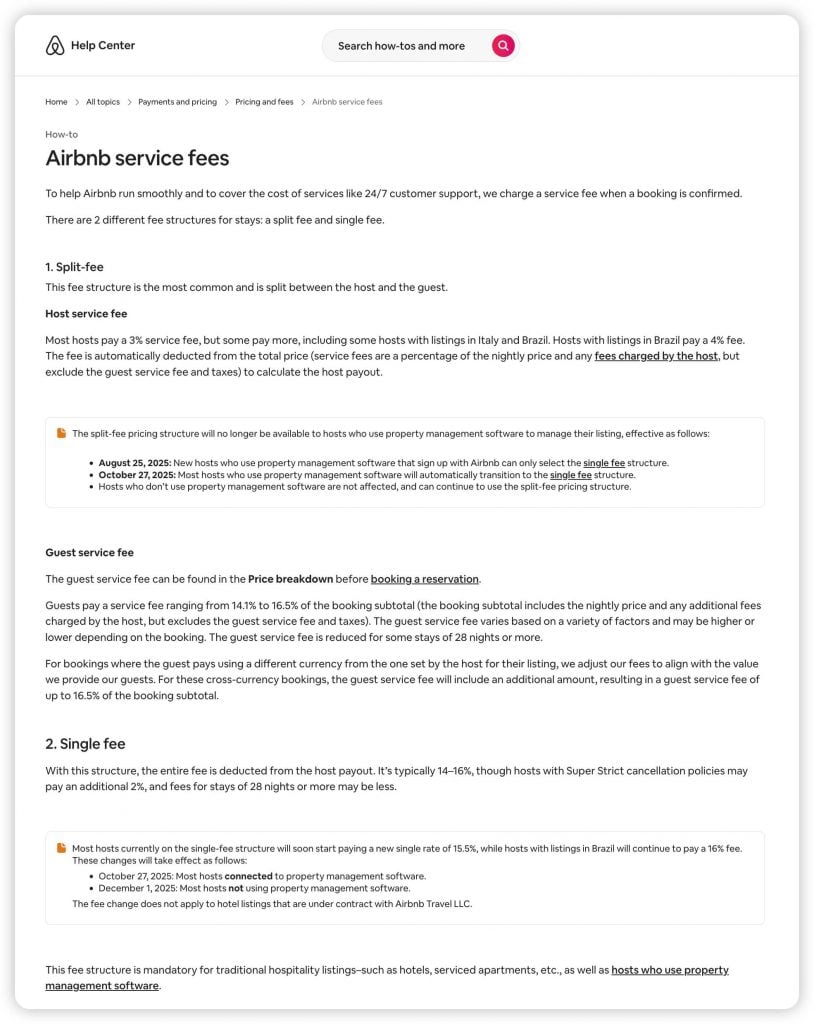
Airbnb charges a service fee on nearly every booking. In 2025, the platform renamed its host-only structure the “single fee” and tightened who must use it (Central de Ajuda do Airbnb). Two structures still describe how that fee works.
Taxa dividida
Under the split model, the cost is split.
The host pays about 3 percent (4 percent in Brazil). The guest pays a separate fee of 14.1–16.5 percent on top of the nightly rate. The guest sees that the guest fee is itemized before they pay.
Taxa única
Under the single model, one fee comes out of the host payout.
Most hosts pay 15.5 percent. The rest typically pay 14–16 percent, and listings in Brazil and Mexico pay 16 percent. Guests no longer see a separate Airbnb service line at checkout.
Airbnb says the move simplifies pricing because guests see one total instead of a base rate plus a separate charge (Airbnb official update).
What Changed with the Airbnb Single Fee?
1. A New Name
Since 2020, Airbnb offered two structures: split fee and host-only fee. Now, the new single fee replaces the host-only fee. Este novo termo reflete a mudança na forma como as taxas são calculadas e deduzidas do pagamento do anfitrião.
2. Who It Applies To
The single fee is mandatory for traditional hospitality listings such as hotels and serviced apartments. It is also mandatory for hosts who use property management software.
In the past, hosts in the United States, Canada, the Bahamas, Mexico, Argentina, Taiwan, and Uruguay could keep split pricing if they used a PMS. And now, that exception is gone.
3. The Fee Percentage
As alterações nas porcentagens de taxas sob a nova estrutura de taxas do Airbnb são as seguintes:
- Com a antiga estrutura de taxas "Somente Anfitrião", os anfitriões normalmente pagavam cerca de 151 TP3T. Com a nova estrutura de taxas "Únicas" do Airbnb, esse valor aumentou ligeiramente para 15,51 TP3T.
- Com a estrutura de “taxa dividida”, a maioria dos hosts pagava uma taxa de serviço de 3% a 5%. Esta foi substituída por uma taxa fixa. 3% taxa de serviço para anfitriões, embora alguns anfitriões em países como Itália e Brasil ainda possam pagar taxas mais altas.
- The guest service fee used to range between 11% and 12% of the booking subtotal. Now, it has increased to 14.1% to 16.5%.
| Split Fee (old) | Single Fee (current) | |
| Who pays | Host + guest | Host only |
| Host rate | About 3% (4% Brazil) | 15.5% for most; 14–16% rest; 16% Brazil, Mexico |
| Guest rate | 14.1–16.5% at checkout | None shown at checkout |
| Charged on | Nightly + host fees (guest side) | Full subtotal: nightly + cleaning + extras |
| PMS hosts | Could keep split (some countries) | Required |
| Bookings already made | n/a | Keep original structure |
Por que a mudança nas taxas do Airbnb gerou tanto debate?
1. Um aumento significativo nas taxas
Com a estrutura de taxas divididas, os hóspedes pagavam uma taxa de serviço que variava de 14,11 TP3T a 16,51 TP3T. Somando-a à parcela do anfitrião de 31 TP3T, o Airbnb cobrava efetivamente entre 17,11 TP3T e 19,51 TP3T do total de cada reserva.
Com a estrutura de taxa única, os anfitriões pagavam inicialmente 15%, mas agora esse valor aumentou para 15,5%.
Esse aumento é certamente frustrante para os anfitriões, embora o Airbnb tenha fornecido algum tempo de reserva para a transição. O aumento nas taxas impacta diretamente as estratégias de preços e a lucratividade dos anfitriões e, indiretamente, afeta a competitividade e as taxas de reserva de seus anúncios.
2. Ambiguidade na Linguagem
As novas regras do Airbnb parecem ser bastante detalhadas e completas, com uma explicação clara de tudo o que os anfitriões precisam saber. No entanto, algumas das explicações são vagas e usam linguagem ambígua, causando confusão entre muitos anfitriões.
Por exemplo, a Airbnb usa frequentemente o termo “a maioria dos anfitriões, mas isso levanta uma questão comum: a quem exatamente se refere a expressão "a maioria dos anfitriões"? Os anfitriões querem saber: "Estou incluído no grupo 'da maioria' ou serei excluído?"
Na verdade, no passado, o Airbnb utilizou terminologia semelhante, o que pode ser entendido como uma forma de a plataforma deixar espaço para interpretação. Isso permite que eles lidem com potenciais reações negativas de forma mais eficaz.
Por exemplo, quando o Airbnb introduziu a taxa exclusiva para anfitriões em 2020, ela foi inicialmente implementada globalmente. No entanto, talvez devido a fortes solicitações de certas regiões, o Airbnb teve que oferecer exceções para anfitriões em países como EUA, Canadá, Bahamas, México, Argentina, Taiwan e Uruguai.
3. Declarações contraditórias
A documentação do Airbnb inclui duas isenções de responsabilidade específicas que causaram confusão entre os anfitriões:
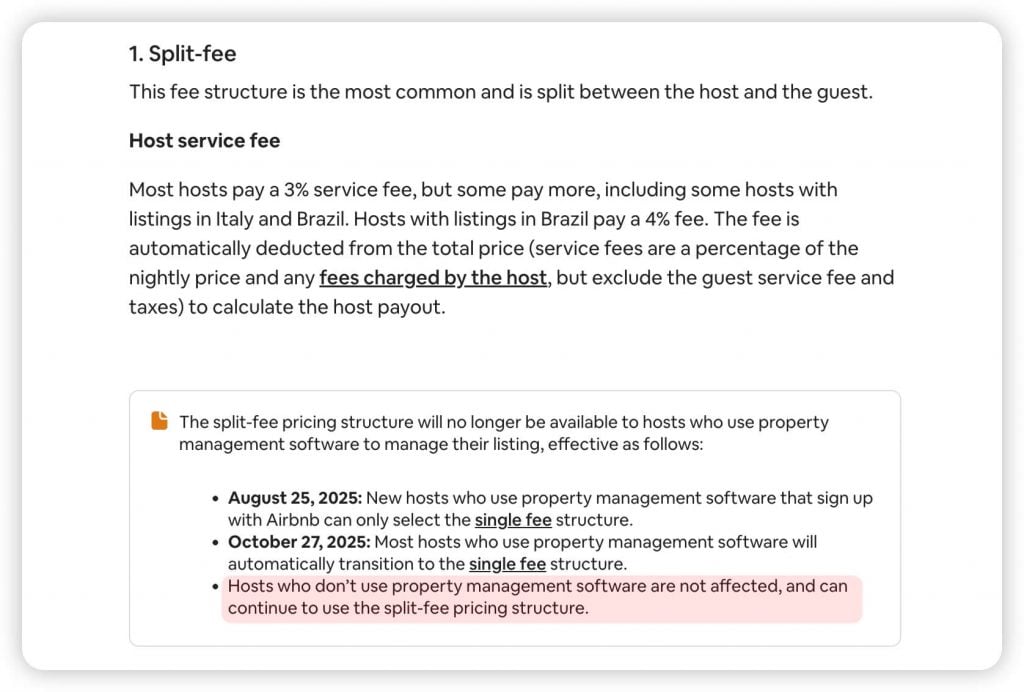
A primeira declaração diz: “Os anfitriões que não usam software de gerenciamento de propriedades não são afetados e podem continuar a usar a estrutura de preços de taxas divididas."
No entanto, a segunda declaração diz: Essas mudanças entrarão em vigor para “A maioria dos anfitriões não usa software de gerenciamento de propriedades a partir de 1º de dezembro de 2025."
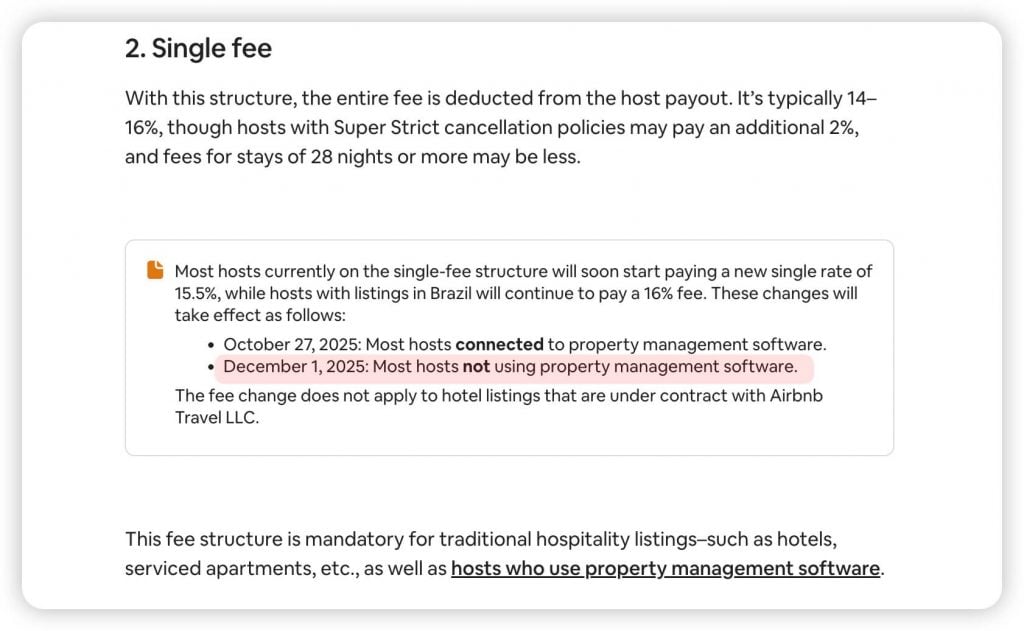
Essas duas declarações parecem se contradizer, deixando os anfitriões que não usam software de gerenciamento de propriedades incertos sobre qual é a política real.
Na realidade, a intenção do Airbnb parece ficar mais clara no início do segundo parágrafo, onde ele menciona: “A maioria dos anfitriões que atualmente usam a estrutura de taxa única em breve começarão a pagar uma nova taxa única”. Em outras palavras, os anfitriões que anteriormente optaram pela estrutura de taxa somente para o anfitrião, independentemente de usarem ou não um software de gerenciamento de propriedades, verão sua taxa aumentar para 15,5%.
Pelo que entendi, o Airbnb não está dizendo que todos os anfitriões serão forçados a mudar para a estrutura de taxa única a partir de 1º de dezembro de 2025, mas sim que aqueles que antes usavam a taxa somente para anfitriões sofrerão um aumento na taxa.
How the Single Fee Affects Your Payout
The fee now lands on the whole booking subtotal, including cleaning, pet, and extra-guest fees. Taxes and security deposits are excluded. That changes your math, and it means cleaning fees now carry the 15.5 percent haircut too. Here is a simple example using round numbers.
Say you listed at 100 under the old split model. You kept about 97 after the 3 percent host fee. Under the single fee at the same 100 price, Airbnb deducts 15.5 percent. Your payout becomes about 84.50.
That is roughly a 12–13 percent drop on every future booking, not a one-time hit.
To hold your payout steady, raise your listed price. Moving from 100 to about 115 keeps your take near 97, because 115 minus 15.5 percent equals about $97. Another way to frame it: divide your target payout by 0.845. The result is the listed price you need.
These figures are examples only. Your real rate depends on your location, cancellation policy, and listing type. They are not tax or financial advice.
How to Reprice Your Listings: Step by Step
You do not need to guess. Follow four steps.
Step 1: Check Your Current Fee Structure
Open Airbnb, go to Today, then Menu, then Earnings. Select a reservation and look under Host payout. The host service fee line tells you which structure is active.
Step 2: Use Airbnb’s Price Adjustment Tool
Airbnb built an in-app tool that adjusts prices across all your listings at once. Run it before your deadline so payouts stay level. If you prefer manual control, apply the divide-by-0.845 formula listing by listing. Do not raise prices so high that your listing looks expensive next to your other channels. Reprice with your whole distribution in mind.
Step 3: If You Use a PMS Like Hostex
Hosts who manage listings through Hostex were part of Airbnb’s earliest migration wave. The fee structure follows Airbnb’s PMS rollout, so there is no manual switch to flip. Open your Hostex pricing settings to confirm the rate, then adjust your listed price there. Because Hostex keeps Airbnb pricing in sync with your other connected channels, one reprice updates every channel instead of just one.
Step 4: Re-check Your Payout
After repricing, open a test reservation or the Earnings view and confirm the host payout matches your target. If it is low, nudge the listed price up by another percent or two.
VAT note: In countries that charge VAT on service fees, Airbnb’s tool adds the tax automatically unless you are VAT-registered and self-assess. The guest still sees one clean price.
If you manage more than a few listings, repricing them one by one gets old fast. Hostex runs the whole job from one dashboard that keeps your prices in sync across every connected channel. Its batch editor changes many listings together by a set percentage or a fixed amount, and its price-copy tool brings another OTA’s rate directly into Airbnb when you want the channels to match. Beyond pricing, Hostex automates messaging, guest communication, and day-to-day operations, with plans starting at $4.9 per month.

FAQ about Airbnb Single Fee
When did the Airbnb single fee become mandatory?
The rollout ran in waves from late 2025. The final groups moved on September 15, 2026 (outside the EU) and October 13, 2026 (inside the EU).
What happens if I do nothing?
Your listed price stays the same, but Airbnb deducts 15.5 percent from your payout. Expect roughly 12–13 percent less per booking.
How do I keep my payout the same?
Raise your listed price by about 15 percent, or divide your target payout by 0.845. Airbnb’s price adjustment tool does this across all listings at once.
Does this affect bookings I already accepted?
No. Reservations confirmed before your switch keep the fee structure they were booked under.
I use Hostex. Do I need to change anything?
Your fee structure followed Airbnb’s PMS migration automatically. Confirm the rate in Hostex pricing settings and reprice there so every connected channel stays aligned.
Is the fee charged on my cleaning fee too?
Yes. The 15.5 percent applies to the full booking subtotal, which includes cleaning, pet, and extra-guest fees. Taxes and security deposits are excluded.
Conclusão
Airbnb’s single fee changes more than the percentage deducted from each booking. It can affect your pricing, payouts, and overall profitability, especially if you manage multiple listings or use a PMS. The best approach is to understand which fee structure applies to your listings, adjust your rates based on your target payout, and regularly review your earnings as Airbnb updates its policies.
More broadly, keeping up with vacation rental platform policies is an essential part of running a profitable short-term rental business. Airbnb and other OTAs can change fees, pricing rules, and requirements over time, so staying informed helps you avoid unexpected costs and make better decisions about your distribution strategy.


 Portuguese
  English
  Japanese
  Spanish
  Arabic
  French
  Russian
  German
  Korean
  Italian
  Thai
Thai