
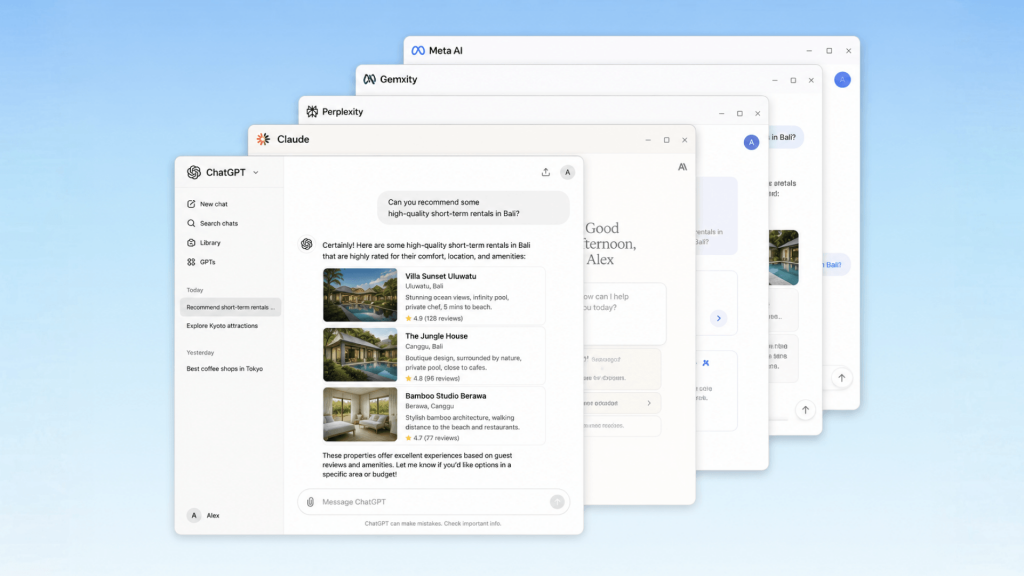
Traditional vacation rental marketing strategies, such as ranking on Google and OTA platforms, still matter. However, AI search optimization for vacation rentals is becoming increasingly important.
You have probably noticed this shift already. People no longer rely only on traditional search results when making decisions. Instead, more users are turning directly to AI systems for answers. Travelers planning trips are no exception.
In this guide, you will learn practical and easy-to-understand ways to improve LLM visibility, optimize listings for ChatGPT Search, and make your เว็บไซต์จองตรง more AI-friendly.
สรุปสั้นๆ: To improve AI discoverability, vacation rental businesses should focus on:
- clear and factual property descriptions
- consistent business information across platforms
- strong guest reviews and review responses
- topical authority through local travel content
- structured data and AI-readable website content
- mentions across trusted travel websites and media sources

What Is Generative Engine Optimization (GEO)?
Generative Engine Optimization is the practice of making your content visible to AI-powered search and recommendation systems.
The concept emerged in 2024 when researchers from IIT Delhi and Princeton University published a foundational paper on GEO. Their research showed that AI systems prioritize content that is structured, authoritative, and semantically clear when generating responses.
Unlike traditional SEO, which focuses on ranking higher in blue-link search results, GEO aims to get your content cited, referenced, and recommended within AI-generated answers.
| การทำ SEO | จีโอ |
|---|---|
| Targets search engine algorithms | Targets AI comprehension and citation |
| Focuses on keywords and backlinks | Focuses on semantic clarity and structured data |
| Measures rankings and traffic | Measures AI citations and brand mentions |
| Optimizes for click-through | Optimizes for answer inclusion |
Why Vacation Rental Listings Need GEO Now
Consider these scenarios that are already happening – A traveler asks ChatGPT: “Find me a family-friendly vacation rental in Orlando with a pool and proximity to Disney.”
In each case, the AI generates an answer by synthesizing information from multiple sources, like:
- websites
- ความคิดเห็นของแขก
- structured business data
- online citations
- forums
- travel blogs
- knowledge graphs
- แพลตฟอร์มการจอง
One of the biggest shifts in AI discoverability is this: AI systems trust consensus more than marketing copy.
If your vacation rental brand appears consistently trustworthy and relevant across multiple platforms, AI systems become more likely to surface your business in future AI-generated answers.
In other words, if your listing, website, or content is not structured for AI comprehension, you will not appear in these answers.
This represents a new channel for visibility that did not exist two years ago.
How AI Systems Retrieve Vacation Rental Information
Many hosts create listings that humans can understand, but AI systems cannot confidently interpret. If the system cannot confidently verify your property details, it may simply exclude you from recommendations entirely.
This is where many GEO for vacation rentals articles stop being practical. To improve AI discoverability, you first need to understand how modern AI systems actually process information.
The good news is that you do not need a technical background to understand this.
Step 1: AI Systems Identify the Main Entity
Before an AI system recommends your property, it first tries to figure out what your business actually is.
In AI search, entities matter more than webpages. An entity can be:
- your vacation rental brand
- an individual property
- a location
- a host company
- a neighborhood
- a landmark
- an amenity category
For example, the phrase “luxury cabin in Broken Bow with hot tub” already contains several important entities:
- Broken Bow
- luxury cabin
- hot tub
- เช่าพักร้อน
When these entities appear consistently across your website and other platforms, AI systems become more confident about understanding and recommending your property.
Step 2: AI Looks for Consistency Across Multiple Sources
This is one of the biggest differences between traditional SEO and AI search optimization for vacation rentals.
Google may rank a page because of backlinks, domain authority, or keyword relevance. AI systems work differently. They try to determine whether multiple trusted sources describe your business in a consistent way.
For example, your website may describe a property as: “Top-rated beachfront villa in Destin.” AI systems may then compare that information against:
- Google reviews
- รีวิว Airbnb
- travel blogs
- Reddit discussions
- local directories
- business listings
- social media mentions
If the information aligns across platforms, your credibility becomes stronger. However, if details frequently conflict, AI confidence drops.
That is why factual consistency matters so much for vacation rental GEO.
Step 3: AI Systems Retrieve Supporting Information Before Answering
Modern AI tools do not simply invent answers. Before generating a response, they retrieve supporting information from different sources.
You do not need to remember technical terms here. The important point is simple: AI systems prefer content that is easy to extract, summarize, and verify.
That means your content should be clear, specific, factual, and easy to understand.
Pages filled with vague marketing language usually perform poorly in AI retrieval systems. Clear and descriptive content performs much better.
ตัวอย่างเช่น:
❌ “Experience unforgettable luxury in paradise.”
✅ “4-bedroom beachfront villa in Gulf Shores with private pool, Gulf views, outdoor kitchen, and direct beach access.”
The second example gives AI systems concrete information they can actually understand and reuse. That is exactly what makes content more AI-friendly.
Practical GEO Strategies for Vacation Rental Hosts
As mentioned earlier, traditional SEO primarily focuses on ranking web pages, improving click-through rates, and targeting keywords. Vacation rental GEO focuses on something quite different.
Modern AI systems pay much closer attention to signals such as:
- factual consistency
- entity authority
- review sentiment
- contextual relevance
- citation patterns
- semantic clarity
- cross-platform consistency
To improve LLM visibility and AI discoverability, you need to optimize deliberately for these signals.
1. Structure Your Content for AI Extraction
AI systems excel at parsing clearly structured content. Apply these principles to your listing descriptions, website content, and blog posts:
Use clear heading hierarchies
Break content into H2 and H3 sections with descriptive labels. Instead of “About Our Property,” use “Family-Friendly Features: Pool, Game Room, and Disney Proximity.”
Include FAQ sections
AI systems frequently extract Q&A pairs for direct answers. Add FAQ sections to your property pages covering common questions: “Is the property pet-friendly?” “What is the cancellation policy?” “How far is the nearest beach?”
Write concise, factual paragraphs
AI struggles with flowery, vague descriptions. Replace “Experience the magic of our enchanting retreat” with “The property features 3 bedrooms, 2 bathrooms, a private pool, and is located 0.3 miles from the beach.”
Use lists and tables
Structured data formats are easier for AI to parse. Compare amenities in tables, list house rules as bullet points, and outline check-in procedures in numbered steps.
2. Build Topical Authority
AI systems prefer sources that demonstrate expertise across a topic area rather than isolated pages. For vacation rental hosts, this means you should develop definitive resources on topics relevant to your market.
If your primary focus is Orlando vacation rentals, create content about that. Examples include:
- Best family restaurants in Orlando
- Disney trip planning guide
- Rainy day activities in Orlando
- Safest neighborhoods near Disney
- Family packing checklist
This signals to AI systems that you are an authority on Orlando travel, not just a property owner. AI systems begin associating your website with “family travel in Orlando.” That strengthens recommendation potential.
One more thing you should know: stale content loses authority. Review and refresh your guides monthly or quarterly with new information, updated statistics, and current local recommendations.
3. Optimize Business Data Accuracy
One of the most important concepts in modern GEO is Entity SEO. The stronger and more consistent these relationships appear online, the easier it becomes for AI systems to trust your property.
Standardize your NAP (Name, Address, Phone)
Ensure your business name, address, and phone number are identical across your website, Google Business Profile, Airbnb listing, VRBO listing, Booking.com, Yelp, and any other directories.
Claim and verify listings
Unclaimed listings may contain outdated or incorrect information that AI systems could cite instead of your preferred content.
Monitor for inaccurate mentions
Use tools to track brand mentions across the web. When you find incorrect information about your properties, contact the site owner to request corrections.
4. Build a Direct Booking Website That AI Systems Can Understand
Many vacation rental hosts still rely entirely on OTA listings. However, direct booking websites are becoming increasingly important for AI visibility and long-term brand control.
A well-structured direct booking website gives AI systems clearer access to your property data, amenities, location details, policies, and brand information. It also helps strengthen entity consistency across platforms.
For example, Hostex Direct Booking Website Builder allows hosts to create AI-friendly booking websites while also supporting one-click distribution to Google Vacation Rentals. This helps properties appear across Google’s travel ecosystem while maintaining direct booking ownership.
5. Implement Schema Markup
Schema markup is structured data that helps search engines and AI systems understand your content.
For vacation rental properties, implement:
- LodgingBusiness schema – Markup your property type, address, amenities, and contact information
- FAQPage schema – Structure your FAQ sections so AI can directly extract questions and answers
- HowTo schema – For content like “How to Check In” or “How to Use the Smart Lock.”
- Review schema – Aggregate rating markup for your property reviews
- BreadcrumbList schema – Help AI understand your site structure
Schema markup does not directly improve rankings, but it significantly increases the likelihood that AI systems can accurately extract and cite your content.
6. Use AI-Readable Descriptions
Your listing descriptions on Airbnb, VRBO, and your direct booking site should balance human appeal with AI comprehension:
Lead with specifics
Open with concrete details: “3-bedroom beachfront condo in Destin, Florida, sleeps 8, private balcony with Gulf views.”
Include location context
Mention specific landmarks, distances, and neighborhood names. “0.4 miles from Pier Park, 12-minute drive to Destin Harbor Boardwalk.”
Highlight unique differentiators
What makes your property distinct? “Only rental in the building with a private rooftop terrace and outdoor kitchen.”
Avoid generic superlatives
“Best location ever” and “amazing views” provide no extractable information. Replace with measurable claims.
7. Create Content That Answers Specific Questions
Research what travelers ask about your market and create content that directly answers those questions:
Use “People Also Ask” data
Search Google for keywords related to your market and note the questions in the “People Also Ask” boxes. Create content that answers each question comprehensively.
Monitor AI search queries
Tools like Profound and Addlly AI can show you what users are asking AI systems about your brand and market.
Build answer-targeted pages
Create dedicated pages for high-value questions: “Is [Your City] safe for families?” “What is the best time to visit [Your Region]?” “How much does a vacation rental in [Your Area] cost?”
8. Promote Across Multiple Trusted Channels
LLM systems tend to trust businesses that are repeatedly mentioned across multiple authoritative sources. In many cases, contextual mentions carry more value than sheer backlink volume.
In other words, AI systems care less about how many random websites link to you, and more about whether credible sources consistently talk about your business in relevant travel contexts.
That is why building high-quality visibility across different channels is becoming increasingly important for vacation rental GEO and AI discoverability.
If possible, try to earn mentions from trusted and travel-relevant sources such as local travel blogs, tourism websites, destination guides, podcasts, YouTube channels, and niche travel publications. These types of mentions help AI systems better understand your brand, location relevance, and industry authority.
9. Optimize Your Reviews for AI Discoverability
Most hosts think reviews only influence rankings on platforms like Airbnb or Google. However, in many cases, LLM systems also rely heavily on review data when generating recommendations.
Positive Reviews Increase Trust
AI models are not only reading your listing description. They are also trying to understand how real guests feel about staying at your property.
Consistently positive reviews help strengthen credibility and trust signals. On the other hand, unresolved negative feedback can weaken AI confidence in your listing.
Review Content Can Create Additional Visibility
Modern AI systems identify patterns across guest feedback and use those signals to match properties with specific traveler intent, even if your listing description never explicitly mentions certain keywords.
For example, if multiple reviews mention quiet mornings, fast Wi-Fi, and a work-friendly layout, your property becomes more likely to appear in searches such as “best Airbnb stays for remote work in Asheville.”
Respond to Reviews Professionally
Professional and thoughtful responses to negative reviews can strengthen trust signals across multiple platforms. They also help AI systems understand that your business actively manages guest experience and communication.
How to Measure and Monitor Vacation Rental GEO Performance
Unlike traditional SEO, which has clear metrics like keyword rankings and organic traffic, vacation rental GEO is still evolving. There is no universal “AI ranking” score yet.
However, you can still track several useful signals to evaluate your AI discoverability and LLM visibility.
1. Monitor AI Citations
One of the most direct ways to measure GEO performance is by checking whether AI systems mention your business in generated answers.
You can manually test platforms such as ChatGPT, Gemini, Anthropic Claude, or Google AI Overviews by asking travel-related questions connected to your market.
ตัวอย่างเช่น:
- “Best family vacation rentals in Scottsdale”
- “Top beachfront villas in Destin”
- “Best direct booking vacation rental websites in Sedona”
You can also use AI visibility tools such as Profound or Addlly AI to monitor brand visibility across AI systems.
2. Track Brand Mentions Across the Web
AI systems often evaluate how frequently your business is mentioned across trusted online sources.
Because of this, brand mention tracking is becoming increasingly important for AI SEO for Airbnb and direct booking websites.
You can monitor mentions using tools such as:
- Google Alerts
- Mention
- Ahrefs Alerts
3. Analyze Direct Traffic and Branded Searches
Another useful signal is direct traffic growth.
If more users begin visiting your direct booking website directly or searching for your property name specifically, it may indicate that AI-generated recommendations are increasing brand awareness.
Pay attention to:
- branded keyword searches
- direct website visits
- referral traffic patterns
- increases in repeat visitors
These signals often reveal visibility shifts before traditional SEO tools do.
FAQs about Vacation Rental GEO
What is the difference between GEO and SEO?
SEO optimizes for search engine rankings in traditional blue-link results. GEO optimizes for inclusion in AI-generated answers and recommendations. Both are necessary, but they target different discovery mechanisms.
Do I need to choose between GEO and SEO?
No. The strategies complement each other. Strong SEO foundations, including technical performance and backlink profiles, support GEO efforts. GEO-specific tactics like structured data and FAQ sections also improve traditional search performance.
How long does it take to see GEO results?
GEO is a longer-term strategy than paid advertising, but can show initial indicators within 3-6 months. AI citation tracking tools can help you monitor progress as you implement GEO tactics.
Is GEO only for large property management companies?
No. Individual hosts can implement GEO strategies by structuring their listing descriptions, creating local guide content, and ensuring consistent business information across platforms.
What tools can I use to monitor AI citations?
Emerging tools like Profound, Addlly AI, and Surfer’s AI visibility features can track how often your brand appears in AI-generated responses. Manual checks using ChatGPT, Perplexity, and Google AI Overviews are also valuable.
Does GEO apply to Airbnb’s internal search?
Airbnb’s search algorithm is separate from general AI search engines, but the principles of clear, structured content with specific details apply to both. Airbnb has announced plans to integrate LLMs more deeply into its platform, which may increase the overlap between GEO and Airbnb optimization.
ความคิดสุดท้าย
AI is changing how people discover information, compare options, and make decisions, and the vacation rental industry is no exception. As travelers increasingly turn to AI-powered tools for trip planning and recommendations, being visible in traditional search results may no longer be enough.
This does not mean SEO is becoming irrelevant. Instead, AI for vacation rentals is creating another layer of online visibility that hosts and property managers need to consider. The businesses that provide clear information, maintain consistent data, build genuine authority, and create useful content will be better positioned to be understood by both search engines and AI systems.
GEO is still an evolving field, and there is no single formula for appearing in AI-generated recommendations. But the fundamentals are becoming clear: make your property easy to understand, easy to verify, and genuinely useful to travelers.
As AI continues to reshape industries and consumer behavior, adapting early can help your vacation rental brand stay discoverable across the places where future guests are looking for their next stay.


 Thai
Thai  English
  Japanese
  Spanish
  Arabic
  French
  Russian
  German
  Portuguese
  Korean
  Italian