
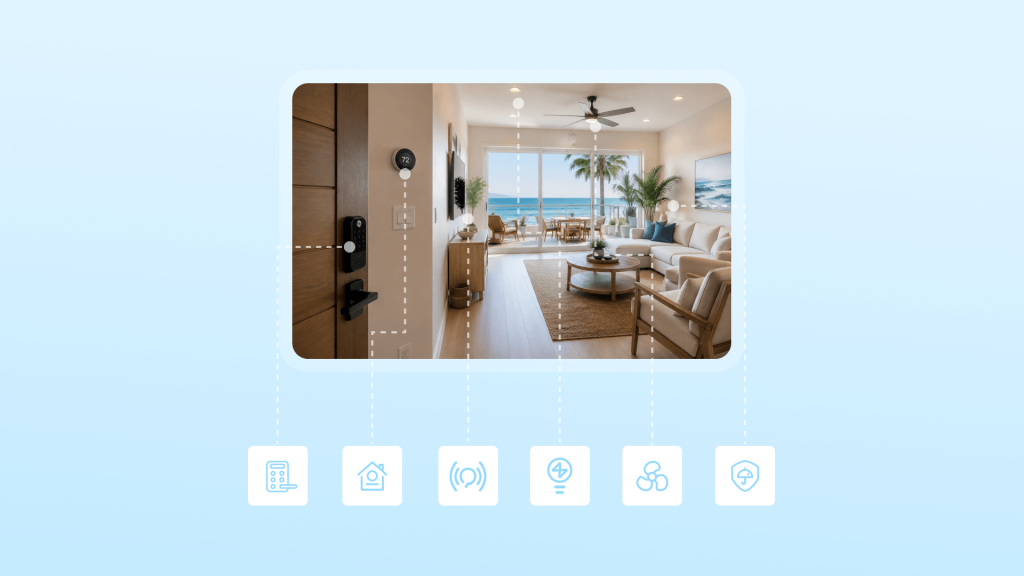
Most hosts treat energy-efficient upgrades as a feel-good expense. It’s something you do to shrink your carbon footprint, not to grow the business. That framing costs you money.
A well-chosen efficiency upgrade does two jobs at once: it cuts the utility bill on every single booking, and it makes the listing more attractive to a guest pool that increasingly filters for sustainability. As part of your vacation rental property setup, these improvements can also strengthen your property’s long-term operating efficiency.
This guide covers which upgrades actually pay for themselves, how to turn them into a booking advantage, and how to run the whole thing without adding hours to your week.
باختصار شديد
- Efficiency upgrades pay back through three channels: lower per-booking operating cost, a pricing/occupancy edge with sustainability-minded guests, and better reviews from steadier comfort.
- Fastest paybacks: a smart thermostat, LED lighting with occupancy sensors, a smart lock, and a whole-home energy monitor.
- The upgrades only pay if they run on every booking. A property management system, not your memory, is what keeps that consistent.
How Energy Efficiency Boosts Vacation Rental Revenue
Before spending a dollar, know where the return comes from. There are only three sources, and they stack.
1. Lower Operating Cost Per Booking
This is the obvious one. Every kilowatt you don’t waste is margin you keep at the same nightly rate.
On a high-turnover property with constant heating, cooling, and hot-water cycles, the savings compound over dozens of stays per month.
For example, for a two-bedroom coastal property with year-round bookings:
| Annual utilities | Notes | |
|---|---|---|
| Before upgrades | $3,600 | Baseline |
| After upgrades | $2,950 | Smart thermostat + LED + low-flow + monitor ($900 install) |
| Annual saving | $650 | ~17-month payback, then pure margin |
2. Pricing and Occupancy Lift From Guest Demand
Booking platforms have spent the last few years building sustainability filters and badges, including Airbnb’s green features و Booking.com’s Travel Sustainable, and similar programs elsewhere.
Guests who use those filters are pre-qualified buyers, and a visibly efficient home lets you command a small premium or win the booking in a tight comparison.
3. Better Reviews From Comfort
A home that holds a steady, comfortable temperature and doesn’t shock guests with confusing old equipment reads as “they thought of everything.” That shows up in review language, and review quality is still one of the strongest ranking signals on every OTA.
None of these require you to preach about the environment to your guests. The upgrade does the talking.
The Highest-ROI Energy Efficient Upgrades for Vacation Rentals
Not every “green” product earns its place.
The table below is the short list that reliably returns its cost on a short-term rental, ordered roughly by payback speed. (Data sourced from Energy Star)
| Upgrade | Upfront cost | How it pays back | الأفضل ل |
|---|---|---|---|
| Smart thermostat | $80–$250 | Cuts heating/cooling ~8%; auto eco mode between stays | Every climate-controlled rental |
| LED + occupancy sensors | $30–$120 | ~75% less energy than incandescent; lights stop burning after checkout | Hallways, storage, utility spaces |
| Smart lock | $120–$300 | Ends key-copy and lockout costs; remote-managed codes | Any keyless-check-in setup |
| Whole-home energy monitor | $150–$400 | Shows exactly which circuit drains power and exposes surprise culprits | Houses with mystery spikes |
| HVAC tune-up/heat pump | $200–$8,000 | Efficient system + utility rebate flips a money-losing bill | Older or poorly sized units |
| Low-flow fixtures + tankless | $100–$1,500 | Cuts hot-water volume without guests noticing | High-shower-traffic properties |
| Solar + EV charger | $3,000–$15,000+ | Premium differentiator in green/EV-minded markets | Coastal, mountain, road-trip markets |
The figures above are representative U.S. retail and install ranges as of 2026. Your actual cost will shift with property size, region, brand choice, whether you self-install, and local labor rates. Read the table as a planning reference, not a quote.
How to Turn Energy Efficient Upgrades Into More Bookings
Efficient hardware only pays if guests actually choose your listing because of it. Most hosts install the gear and then say nothing about it, so the savings stay invisible and the booking edge never shows up.
Here is the concrete sequence to make the upgrade do the selling.
1. Turn on every sustainability filter
Platforms like Airbnb and Booking.com let you tag eco-friendly attributes, and Booking lets you complete Travel Sustainable practices for a badge.
Open each OTA’s listing editor this week and tick the green, EV, and efficiency attributes that apply.
These are filterable fields, so a guest searching “EV charger” or “eco stay” reaches your home instead of scrolling past it.
2. Rewrite the description
Pull every “eco-friendly,” “green,” and “sustainable” phrase and replace it with the outcome the guest feels.
“Smart climate control keeps every room comfortable while keeping your rate fair” beats “eco-friendly and sustainable,” because guests book a feeling first and justify it with facts later.
Keep the environment to one sentence and spend the rest on comfort, quiet, and convenience.
3. Select the right amenities checklist
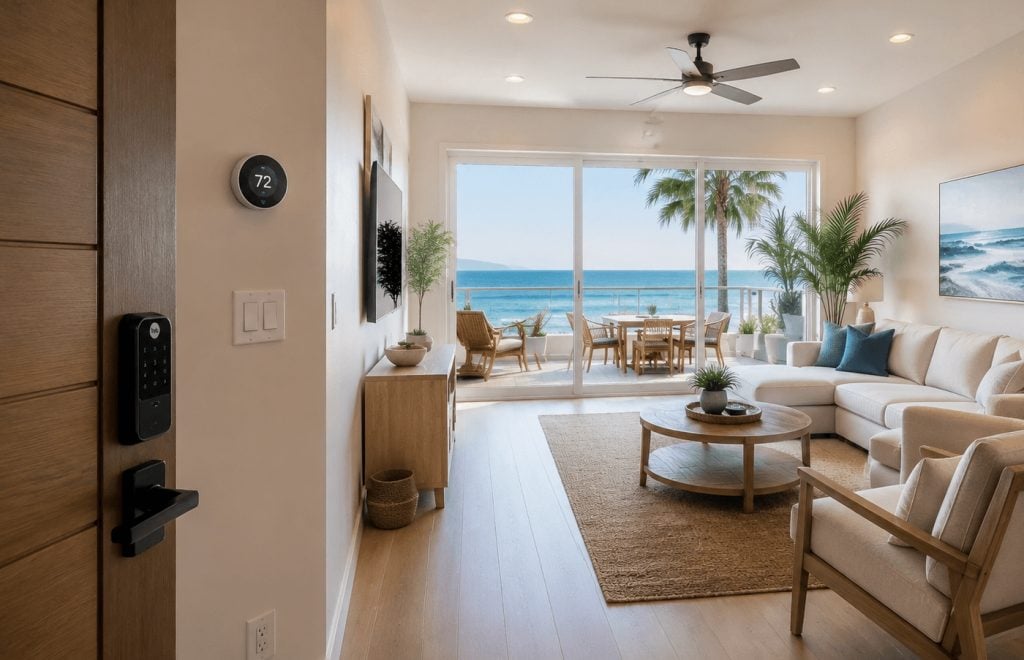
Smart thermostat, keyless entry, LED lighting, and EV charger are searchable amenity tags, not just nice-to-haves.
Tick them wherever the platform offers the option. They cost nothing and put your listing in front of guests who deliberately filter for them.
4. Shoot one hero photo of the tech
A clean, well-lit shot of the smart thermostat on the wall or the EV charger in the driveway signals “modern, maintained home” faster than a paragraph of copy.
Swap one generic interior photo for it, because guests read images before they read text.
5. Badge your direct booking site
On your owned site, you control the message entirely. Add a short line or badge about the efficient, modern setup on your direct booking site and in the guest guide.
This converts the guests who have already decided to book with you and avoids the OTA commission on the rebook.

Energy Efficiency Mistakes That Burn Money
A few patterns turn a smart efficiency plan into a write-off.
- Over-locking guest comfort. A thermostat that refuses to go below 70°F in July generates angry reviews faster than it saves dollars. Efficiency settings should be invisible to comfort, not a battle.
- Buying the cheapest sensors. A $12 occupancy sensor that false-triggers and leaves the garage light on for three days costs more than the premium unit that just works. Reliability beats upfront price on anything that runs unattended.
- Ignoring standby load. Swapping every bulb and leaving a rack of always-on streaming devices, routers, and displays still bleeds 5–10% of household electricity. The monitor exists to catch exactly this.
- Chasing rebates you don’t qualify for. Utility and tax incentives look generous in headlines and disappear in fine print. Confirm eligibility before you spec the project around the credit.
- Never telling the guest how things work. A smart lock with no instructions, or a thermostat hidden behind a custom panel, produces support tickets, not delight. A one-line message solves it.
How to Automate Energy Management
Energy efficiency improvements often fail in practice because they rely on someone remembering to take action before every guest stay.
أ نظام إدارة الممتلكات like Hostex eliminates the need for manual follow-ups by turning energy-saving routines into automated workflows.
1. Automated pre-arrival and checkout messages.
Hostex can send guests detailed تعليمات تسجيل الوصول before arrival and automated checkout reminders when their stay ends. Once الرسائل المفعلة are configured, everything runs automatically without additional effort.
This reduces communication friction, improves the guest experience, and helps prevent unnecessary energy consumption caused by missed instructions.
2. Unified inbox & AI-powered replies.
When guests have questions about property usage, their messages automatically appear in the صندوق بريد موحد with relevant booking details.
هوست جي بي تي, Hostex’s AI-powered reply assistant, helps generate instant responses, allowing guests to get quick guidance without waiting for manual replies.
3. Device schedules connected to real booking data.
Hostex keeps reservation calendars synchronized across channels. Through integrations with smart home providers such as أوبيرتو أو جيرفيس, actual check-in and checkout times can trigger connected devices like smart locks, thermostats, and other systems.
This ensures the property is prepared when guests arrive without relying on rigid time-based schedules.
4. Owner Connect reporting.
For property managers overseeing multiple owners’ homes, اتصال المالك automatically generates monthly owner statements.
This turns operational improvements into measurable performance data rather than abstract efficiency claims.
The hosts who win on efficiency aren’t the ones who buy the most gadgets. They pick upgrades with a real payback. Do that, and the utility bill stops being a cost you tolerate and becomes margin you control.
التعليمات
Do energy-efficient upgrades really increase rental income?
They increase income two ways: lower utility cost per booking (direct margin) and a small pricing or occupancy edge with guests who filter for efficient homes. The income shows up in the utility line and the review score, not as a separate “green revenue” line.
What is the cheapest upgrade with the fastest payback?
LED lighting with occupancy sensors. The bulbs are cheap, last years, and cut a meaningful slice of consumption in a high-turnover home where lights get left on.
Should I install an EV charger for my rental?
If your market sees road-trip or eco-minded travelers, yes. A charger removes a booking objection for EV owners and signals a modern, maintained property. In markets with little EV traffic, the payback is slower.
Will a smart thermostat annoy my guests?
Only if you lock it. Set a comfortable band guests can adjust within, and use the scheduling for the empty periods between stays. Guests notice the comfort, not the control.
How do I prove the savings to a property owner?
Use a whole-home energy monitor and report the utility delta as a line item in their statement. A before-and-after number beats any explanation, and it justifies further upgrades.
 Arabic
  English
  Japanese
  Spanish
  French
  Russian
  German
  Portuguese
  Korean
  Italian
  Thai
Thai