

Resumen: Airbnb Summer Release 2026 is much more than a feature update. It marks a major shift toward an AI-powered recommendation platform. Airbnb can now summarize reviews, understand conversational searches, and compare listings on behalf of guests. As a result, recurring review patterns, detailed listing information, and operational consistency matter more than ever.
For hosts, the biggest takeaway is simple: Airbnb’s AI can only promote what it can clearly understand. Properties with strong reviews, specific descriptions, complete listing details, and reliable guest experiences will gain an advantage. Meanwhile, vague listings and recurring guest complaints may become more visible.
If you take only three actions after reading this guide, do these: audit your reviews for recurring issues, rewrite your listing with specific and measurable details, and ensure every part of your listing accurately reflects the guest experience. In Airbnb’s AI-driven future, clarity and consistency are becoming key ranking factors.

Airbnb’s Biggest Product Shift Since Experiences
When Airbnb launched Experiences in 2016, it marked a major shift in the company’s vision. Airbnb was no longer just a marketplace for places to stay. It wanted to become a platform for travel itself. A decade later, Airbnb may be entering another turning point.
At its Summer Release event on May 20, 2026, Airbnb unveiled a wide range of updates. On the surface, the announcements seemed unrelated. New AI review summaries, conversational search, side-by-side listing comparisons, boutique hotels, airport transfers, grocery delivery, and even a strategic investment in group travel startup WeRoad all appeared in the same presentation.
However, when viewed together, a clear pattern emerges. Airbnb is rebuilding how guests discover, evaluate, and book accommodations. It signals how Airbnb wants the marketplace to function in the years ahead. For hosts, this creates both opportunities and risks.
In this guide, we’ll break down every major announcement, explain what it means for short-term rental hosts, and outline the practical steps you can take to stay competitive as Airbnb’s AI-driven ecosystem continues to evolve.
What’s New in the Airbnb Summer Release 2026
El Airbnb Summer Release 2026 is about much more than new features. Airbnb is building a platform that helps guests discover, compare, and book travel with increasing support from AI. Every update announced this year fits somewhere within that larger strategy.
Some of them are already live, others will roll out later this year.
1. AI Review Highlights
One of the most important updates for hosts is the introduction of AI Review Highlights.
Instead of displaying reviews primarily in chronological order, Airbnb now uses AI to identify recurring themes across a listing’s review history. These themes appear prominently near the top of the listing page.
This change reflects a broader trend across online marketplaces. Guests increasingly want quick summaries rather than reading dozens of individual reviews. Airbnb is now doing that work for them.
For Airbnb hosts, review quality matters more than ever because the platform is actively interpreting guest feedback instead of simply displaying it.
And you should know that Airbnb’s system analyzes patterns across all reviews, not just recent ones. This means that if guests repeatedly mention the same strengths or weaknesses, regardless of when they were posted, the AI is likely to surface them. You cannot simply bury them with new reviews.
2. AI-Powered Listing Comparison
Later in 2026, Airbnb plans to introduce AI-generated listing comparisons. Guests will be able to compare multiple properties side by side using summaries created by Airbnb’s AI.
These comparisons may include factors such as:
- Prices
- Location advantages
- Property layout
- Design style
- Amenities
- Guest suitability
That said, a guest searching for a beachfront condo with parking may immediately see which listings fully meet those requirements and which only partially match them.
Traditionally, guests had to open several tabs and compare listings manually. Airbnb is now bringing that comparison process directly into the booking journey. As a result, listings with vague descriptions or incomplete information may become less competitive.
3. Natural Language Search
Perhaps the most transformative update is Airbnb’s new AI-powered search experience. According to Airbnb, the platform now uses more than 800 signals to understand guest intent.
Instead of entering fragmented keywords, guests can search the way they naturally speak. For example:
Old search behavior
“cabin hiking quiet”
New search behavior
“Quiet cabin near hiking trails for a family of four”
The difference may seem small, but it fundamentally changes how Airbnb matches guests with listings.
The platform is no longer looking only for keywords. It is trying to understand the meaning and context. This makes detailed listing descriptions more valuable than generic marketing language.
A description that mentions fiber internet speeds, walking distances, workspace setups, and nearby attractions provides stronger signals than one filled with broad adjectives.
For hosts who consistently optimize their listing titles and descriptions, that focus will now yield even greater returns.
4. Boutique Hotels Join Airbnb
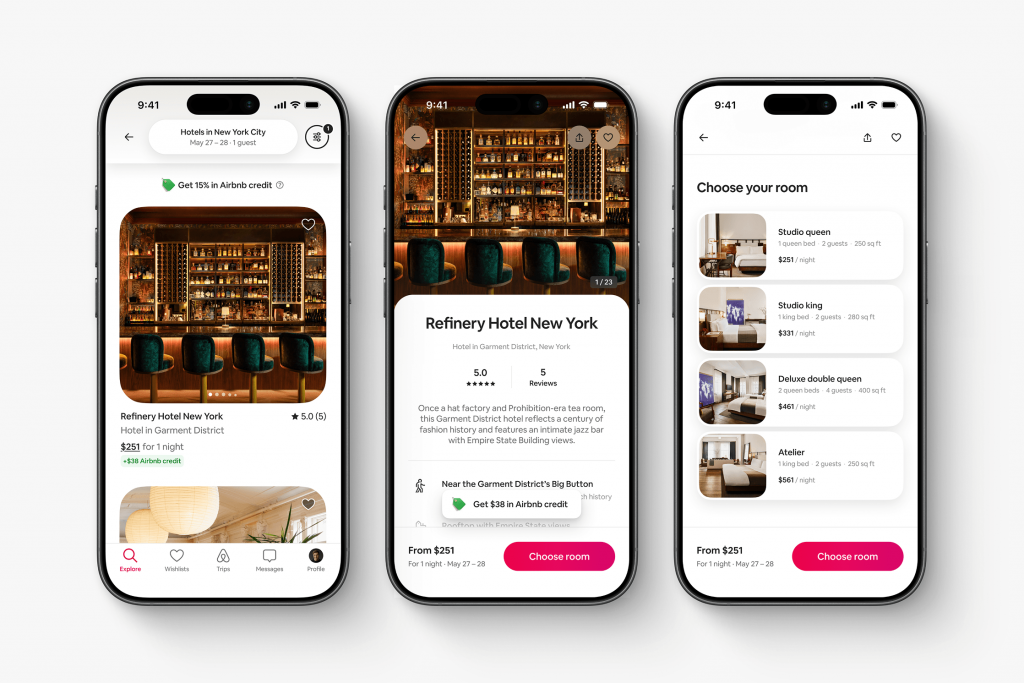
Airbnb is also expanding beyond traditional vacation rentals by adding thousands of boutique and independent hotels. The rollout begins in 20 major cities, including New York, Paris, London, Madrid, Rome, and Singapore.
To encourage adoption, Airbnb is introducing several guest incentives. Guests can receive a price match guarantee if they find a lower hotel rate elsewhere. Certain hotel bookings also include up to 15% credit toward a future Airbnb home stay.
This initiative continues Airbnb’s effort to become a broader travel marketplace rather than a platform focused exclusively on short-term rentals.
For guests, the result is more choice. For hosts, it introduces a new category of competition directly within Airbnb search results.
5. New Guest Services
Another major announcement involves services that extend beyond accommodations. Airbnb wants guests to book more parts of their trip without leaving the platform.
The first wave includes four new offerings:
| Service | Partner | Key Benefit |
|---|---|---|
| Grocery Delivery | Instacart | Free delivery and discounts in eligible cities |
| Airport Transfers | Welcome Pickups | 20% discount on rides |
| Luggage Storage | Bounce | Access to 15,000+ locations worldwide |
| Car Rentals | Airbnb Partners | Vehicle recommendations based on trip needs |
One feature stands out for hosts. In selected markets, grocery orders can be delivered before guest arrival. Hosts may choose to receive and place those items inside the property before check-in. This creates a smoother arrival experience and opens the door to additional hospitality services.
6. FIFA World Cup 2026 Experiences
Airbnb is also preparing for one of the largest travel events in recent history. The company announced exclusive experiences tied to the FIFA World Cup 2026 across host cities in the United States, Canada, and Mexico.
Guests will be able to book activities ranging from watch parties to football training sessions and local fan events.
Beyond the World Cup, Airbnb continues to expand its Experiences marketplace. The company added thousands of new experiences connected to famous landmarks, local culture, and food tourism.
This expansion reinforces Airbnb’s long-term goal of generating revenue beyond accommodations alone.
7. Airbnb’s Investment in WeRoad
One announcement received less attention than the AI features, yet it may prove strategically important. Airbnb led a $58 million funding round for WeRoad, a fast-growing group travel company based in Milan.
The deal gives Airbnb a 10% ownership stake and a seat on WeRoad’s board. More notably, WeRoad CEO Andrea D’Amico has joined Airbnb.
WeRoad specializes in small group travel experiences for Millennials and Gen Z travelers. Participants often join trips as solo travelers and connect through shared interests.
This investment suggests Airbnb sees significant growth potential in organized group travel. It also signals a broader shift toward travel communities, shared experiences, and social discovery.
How the Airbnb Summer Release 2026 Affects Short-Term Rental Hosts
Many hosts will read the Summer Release announcements and focus on individual features.
However, the bigger story is not any single update. The real change is that Airbnb is becoming much better at understanding, evaluating, and presenting listings for guests.
In the past, guests did most of the work. They read reviews, compared listings, and interpreted descriptions themselves. Now Airbnb’s AI is helping them do all three.
That shift has several important implications for hosts.
1. Your Entire Review History Matters More Than Ever
For many hosts, AI Review Highlights may become the most impactful update in the entire release.
Previously, a negative review could gradually fade into the background as new reviews arrived. Now, recurring feedback can remain visible for years if Airbnb’s AI identifies it as a pattern.
Imagine that several guests mentioned thin walls three years ago. Even if your average rating improved afterward, the issue could still appear as a highlighted trait if the platform believes it remains relevant.
The same applies to positive feedback. If guests consistently praise your fast WiFi, smooth check-in process, or spotless cleaning standards, those strengths become more visible as well.
That means every guest stay contributes to a larger narrative about your property. Hosts should pay closer attention to recurring comments than to isolated complaints. Patterns now matter more than individual reviews.
2. AI Will Compare Listings Before Guests Do
Another major change involves how guests evaluate their options. This is especially important in competitive markets where guests are evaluating several similar homes.
Traditionally, travelers opened multiple tabs and compared listings themselves. Soon, Airbnb’s AI will do much of that work automatically.
This creates a new challenge for hosts.
The AI can only compare information that exists. If your listing lacks details about parking, workspace setups, accessibility features, or nearby attractions, Airbnb has less information to present on your behalf. Meanwhile, a competing property with a detailed listing gains an advantage.
Think of your listing as a dataset. The more complete and specific that dataset becomes, the better Airbnb’s AI can represent your property during comparisons.
3. Airbnb SEO Is Becoming More Intent-Driven
As natural language search becomes more common, vague descriptions become less effective.
For years, hosts have relied on repeating popular search terms to improve their Airbnb SEO. Many listings are filled with generic adjectives like “cozy,” “beautiful,” “amazing,” or “perfect location.”
However, these vague words may become ineffective under the new natural language search, as they provide Airbnb’s AI with very little meaningful information. The updated search experience now emphasizes matching intent over simple keyword matching.
Imagine this: as the new natural language search rolls out, travelers are increasingly asking complete questions and making detailed requests. And specific details help Airbnb connect your listing to the right traveler.
4. Boutique Hotels Raise the Quality Bar
If you browse the Airbnb host community on Reddit and Facebook, you’ll notice that the arrival of boutique hotels has sparked concern among many hosts.
In reality, hotels are not necessarily replacing vacation rentals. Many travelers still prefer homes because they want kitchens, extra space, private outdoor areas, or multiple bedrooms.
Boutique hotels do create some challenges – they often excel at presentation. Most hotel listings include:
- Professional photography
- Detailed room descriptions
- Consistent branding
- Standardized guest experiences
For hosts, the lesson is not to compete with hotels directly. Instead, focus on the advantages hotels cannot easily replicate. That may include:
- More living space
- Servicios para toda la familia
- Recomendaciones locales
- Unique design
- Remote work setups
The hosts who clearly communicate those strengths will remain competitive.
5. Group Travel Could Become a Growing Segment
Airbnb’s investment in WeRoad may initially appear unrelated to short-term rental hosting. But it’s important to recognize that Airbnb typically makes strategic investments with long-term objectives in mind.
WeRoad, a platform focused on social travel experiences for younger tourists, signals one likely direction in which Airbnb expects future growth: social tourism and group-based experiences are positioned to play a more significant role in the travel market of tomorrow.
According to company data, roughly 60% of travelers eventually book another WeRoad trip. Hosts who cater to these travelers may benefit from this trend. Many participants travel alone but join organized groups. This audience often values:
- Flexible accommodations
- Shared spaces
- Community experiences
- Recomendaciones locales
The opportunity may be especially strong in cities that attract digital nomads, remote workers, and experience-focused travelers.
6. Guest Services Create Better Experiences
The new services ecosystem may seem less important than the AI updates. However, it could still influence guest satisfaction.
A smoother arrival often leads to a smoother stay. Airport transfers, luggage storage, and grocery delivery all remove common travel frustrations.
Guests often remember those small conveniences when writing reviews. Even if hosts do not directly control these services, they can help guests take advantage of them. A simple mention in a welcome message may improve the overall guest experience.

What Hosts Should Do Right Now
The Airbnb Summer Release 2026 introduces many new features, but hosts do not need to react to everything at once. Some updates may take months to roll out globally. Others are still in testing.
Instead, focus on the areas that will have the biggest impact on visibility, guest satisfaction, and booking performance.
Here are the five priorities that matter most.
Priority #1: Identify and Fix Review Patterns
If there is one task every host should complete this month, it is a review audit. With AI Review Highlights now summarizing guest feedback, recurring issues become much harder to ignore.
Start by reviewing your most recent 50 reviews. Look for comments that appear more than once. If multiple guests mention the same issue, Airbnb’s AI is likely to identify it as part of your property’s story.
Pay particular attention to areas such as:
- Noise complaints
- WiFi reliability
- Limpieza
- Experiencia de registro
- Communication speed
- Bed comfort
Address the root cause first. Then encourage future guests to mention the improvements naturally in their reviews.
Priority #2: Rewrite Your Listing for AI Search
Many Airbnb listings still read like marketing brochures. Unfortunately, AI search systems do not understand vague marketing language very well.
You should replace broad adjectives with measurable details. For example:
| Instead of This | Try This |
|---|---|
| Fast WiFi | Fiber internet with speeds up to 300 Mbps |
| Excelente ubicación | 10-minute walk to downtown and subway access |
| Family-friendly | Crib, high chair, baby gate, and fenced yard |
| Quiet neighborhood | Residential street with limited traffic |
This is easier than it may seem. Try viewing your listing from a guest’s perspective and consider the phrases they would naturally use when searching.
- Someone working remotely may search for reliable internet and a dedicated workspace.
- A family may search for child-friendly amenities.
- A business traveler may prioritize transportation access.
The more specific your listing becomes, the easier it is for Airbnb’s AI to match you with the right guest.
Priority #3: Strengthen Every Listing Signal
This new natural language search experience relies on a wide range of relevance signals. As a result, you should not focus solely on your listing description. Every piece of information that helps showcase your property matters.
Set aside some time to go through your listing from start to finish. Look at it with fresh eyes and make sure nothing important is missing. Ask yourself:
- Are all amenities listed?
- Are photo captions descriptive?
- Are the house rules complete?
- Are nearby attractions clearly explained?
- Are check-in instructions current?
Every completed field gives Airbnb more information to work with.
For example, a caption such as “Dedicated workspace with ergonomic chair and fiber internet” provides significantly more context than an unlabeled photo of a desk.
Small improvements across multiple listing elements often produce better results than rewriting a single paragraph.
Priority #4: Prepare for AI-Powered Comparisons
Soon, Airbnb will help guests compare properties automatically. When that happens, incomplete listings may become more vulnerable.
Review your listing as if it were being compared against three nearby competitors. Ask yourself:
- What makes this property different?
- What amenities deserve more attention?
- What guest type is this property best suited for?
The strongest listings clearly communicate their unique advantages. That could be:
- A walkable location
- A dedicated workspace
- Servicios para toda la familia
- Exceptional outdoor space
- Pet-friendly features
- Luxury design elements
Do not assume guests will discover these strengths on their own. Make them obvious.
Final Thought: Improve Operational Consistency
Airbnb’s new AI tools reward consistency. Properties with reliable service tend to generate stronger reviews, clearer guest expectations, and better overall performance.
This is where operational efficiency becomes important. Response times, calendar accuracy, check-in communication, and guest support all contribute to the experience that eventually appears in reviews.
As your portfolio grows, maintaining that consistency becomes more difficult. Many professional hosts use automation tools to handle repetitive tasks such as:
- Guest messaging
- Sincronización de calendario
- Booking management
- Review requests
- Team coordination
Platforms such as Hostex can help automate these workflows while keeping guest communication timely and consistent.
The goal is to spend less time on repetitive administration and more time creating a better guest experience.


 Spanish
  English
  Japanese
  Arabic
  French
  Russian
  German
  Portuguese
  Korean
  Italian
  Thai
Thai